
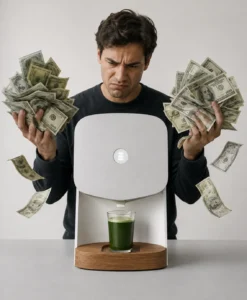
A $699 kitchen appliance that needed a Wi-Fi connection to squeeze a bag of pre-cut vegetables. That was the promise of Juicero, and for about four years it was one of Silicon Valley’s favorite stories. Then, in one 2017 video, two Bloomberg reporters proved you could get the same juice by squeezing the bag with your bare hands. The Juicero failure happened because the company spent $120 million engineering a beautifully over-built solution to a problem – inconvenient juicing – that its own product ultimately proved didn’t require a machine at all. Once that fact became public and undeniable, no amount of design polish or investor pedigree could save the business.
This piece walks through how Doug Evans, a raw-food evangelist with one previous exit, convinced some of the most sophisticated venture firms in the world to fund a juicer; how the company’s internal economics were already strained before the Bloomberg video ever aired; and what happened to Evans, the investors, and the $120 million after the company shut its doors in September 2017.
AT A GLANCE
- Founded: 2013, San Francisco, by Doug Evans
- Total raised: ~$120 million over six rounds (2013–2016)
- Peak valuation: Roughly $270–$500 million, reported at the March 2016 Series B
- Shut down: September 1, 2017
- Root cause: Overengineering the product’s core value proposition collapsed once it was shown to be unnecessary
Table of Contents
Background & Context
From Organic Avenue to a Silicon Valley Juicer
Doug Evans wasn’t a typical first-time founder chasing a hardware idea. He’d already built and sold Organic Avenue, a chain of raw-juice bars in New York, in a deal that reportedly returned some investors six times their money. That exit gave him credibility, capital, and a story: he understood the juice business from the inside, and he believed the industry’s biggest problem was mess and inconsistency, not price.
The Original Pitch
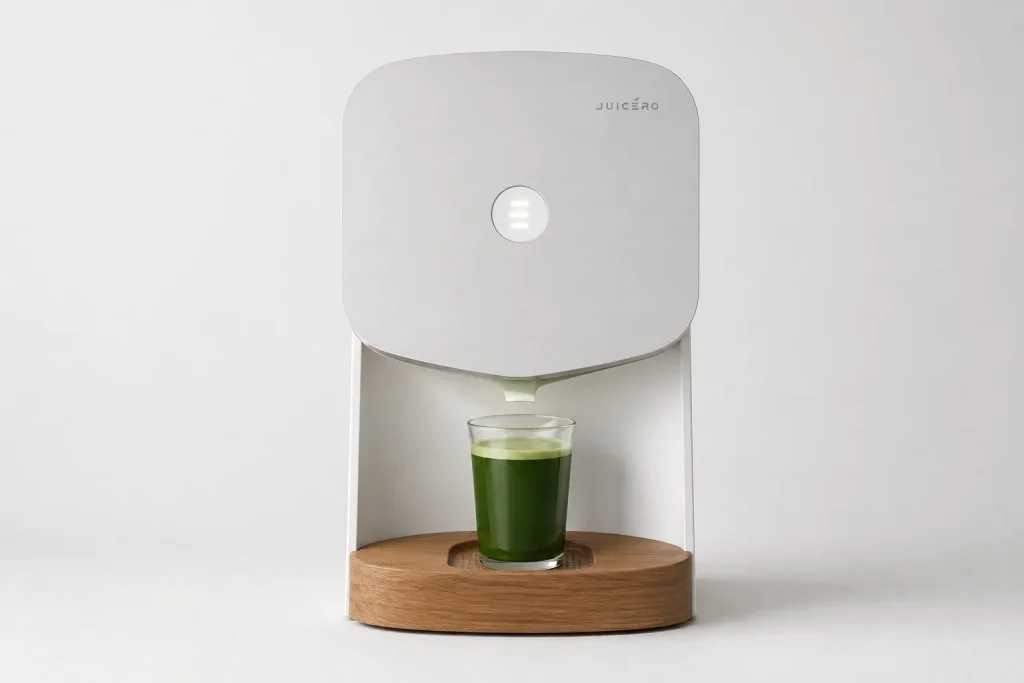
Evans’s answer was a Wi-Fi-connected press that would squeeze proprietary, pre-portioned produce pouches into a perfectly consistent glass of cold-pressed juice, with none of the cleanup or guesswork of a traditional juicer. The pitch fit neatly into two of the decade’s biggest venture narratives at once: the “Internet of Things” wave sweeping consumer hardware, and the wellness boom that had turned cold-pressed juice into a status symbol for health-conscious professionals.
Early Funding and Hype
Evans began raising capital in 2013, and it came easily. By 2016 Juicero had pulled in roughly $120 million across six rounds from investors including Kleiner Perkins, Google Ventures (GV), Thrive Capital, Artis Ventures, and even the Campbell Soup Company, plus a personal investment from NBA star Carmelo Anthony’s venture fund. The company became a fixture in glossy tech and lifestyle press well before it had shipped a single unit, setting up expectations the product would eventually have to meet.
The Rise
Launch and Media Darling Status
The Juicero Press launched in March 2016 at a retail price of $699, alongside a subscription of proprietary produce packs priced between roughly $5 and $8 each, a classic “razor-and-blade” hardware-plus-consumables model. Around the same time, reports pegged the company’s valuation at a range of roughly $270 million to $500 million, a striking figure for a company that had shipped essentially no product yet.
Celebrity Endorsement and Retail Placement
Juicero quickly became a lifestyle-press darling. Oprah Winfrey and Gwyneth Paltrow were reported to be fans, sports teams began stocking the machines, and Whole Foods started carrying the packs. The company leaned into a mission-driven, almost spiritual framing of its product, positioning fresh, cold-pressed nutrition as something close to a lifestyle upgrade rather than a mere kitchen gadget.
A Board-Driven Leadership Change
By October 2016, Juicero’s board increasingly focused on scaling operations rather than founder vision pushed Evans to bring in outside leadership. Former Coca-Cola North America president Jeff Dunn stepped in as CEO, with Evans moving into a Chief Product Officer-style role. On paper, it looked like the standard Silicon Valley playbook: bring in an operator once the visionary founder has proven the concept. At this point, Juicero had raised nearly all of its eventual $120 million and appeared, from the outside, unstoppable a hardware startup that had cracked celebrity culture, retail distribution, and top-tier venture backing simultaneously.
The Cracks Appear
The Economics Were Already Strained
Even before the public collapse, Juicero’s internals told a more fragile story than its press coverage suggested. Reported monthly losses reportedly climbed past $4 million by mid-2017, against revenue that some later reporting estimated at under $1 million as of early that year. That gap between burn and revenue is the financial definition of an unsustainable unit economics problem: the company was spending far more to acquire and serve each customer than it could recover from selling machines and packs.
One of the First Public Warning Signs
January 2017 brought the first visible sign that demand wasn’t meeting expectations: new CEO Jeff Dunn cut the Press’s price from $699 to $399, just ten months after launch. A price cut that steep, that early, is rarely a growth tactic it’s usually a signal that a company is trying to unstick inventory that isn’t moving at the original price point.
The Overengineering Problem, Defined
The deeper issue was what business analysts now generally describe as overengineering building far more technical sophistication into a product than the underlying customer problem actually requires. Evans had marketed the Press’s mechanical force as being able to “lift two Teslas,” a genuinely impressive engineering feat. But that force was being applied to a problem squeezing a soft produce pouch, that didn’t need anywhere near that much pressure to solve.
The Public Narrative vs. Internal Reality
Publicly, through early 2017, Juicero was still framed as a design-forward, IoT-enabled premium wellness brand. Internally, the company was cutting its own price, watching cash burn accelerate, and had just replaced its founder-CEO. The gap between the story being told to consumers and the story unfolding on the balance sheet is a defining feature of nearly every Silicon Valley collapse and Juicero’s version of that gap was about to become public in the most literal way possible.
The Collapse
The Bloomberg Video
On April 19, 2017, Bloomberg published a short video and article under a simple, devastating premise: do you actually need a $400 machine to juice these packs? Two reporters squeezed the produce pouches by hand and got juice yields comparable to the Press itself. The story didn’t accuse Juicero of fraud or safety violations it simply demonstrated, on camera, that the company’s core engineering achievement was optional.
Why This Specific Story Broke the Company
The Bloomberg piece was so damaging precisely because it wasn’t really about juice it was about trust. Juicero’s entire premium pricing argument rested on the idea that the machine was doing something a human couldn’t. Once that argument visibly failed, the $399–$699 price tag stopped looking like a premium and started looking like a punchline. Evans and the company defended the Press’s value on hygiene and consistency grounds, but the “just squeeze it” framing had already taken over the public conversation and proved impossible to walk back.
The Timeline From Video to Shutdown
The company tried to hold on. It publicly discussed further price cuts to both the Press and the produce packs in the months after the video. But by September 1, 2017 roughly four and a half months after the Bloomberg story Juicero announced it was suspending sales of the Press and its produce packs entirely, effective immediately, and offering customers refunds for 90 days. The company said it had sold over a million produce packs but could not make the economics work on its own, and it began seeking a buyer for its patents and technology instead of continuing to operate as a standalone company. No qualified acquirer emerged, and Juicero wound down for good, roughly 16 months after its March 2016 launch and less than four years after its 2013 founding.
Aftermath for Staff and the Business
The shutdown put more than 70 employees out of work and left the company’s roughly $120 million in invested capital largely written off, since no acquisition or continuation of the business followed. The consumer-facing story ended almost as abruptly as it had begun, but the reputational fallout Juicero as shorthand for Silicon Valley excess would outlast the company itself by years.
The Verdict: Why Did They Really Fail?
- Overengineering a non-problem. The Press applied enormous mechanical force to solve a problem inconvenient hand-squeezing that turned out to be easy to solve by hand. The core technical achievement undercut the product’s own value proposition the moment it was tested publicly.
- Price-to-value mismatch. A $699 (later $399) machine plus a recurring $5–$8-per-pack subscription is a steep ask for a benefit slightly more consistent juice that most consumers could approximate for free.
- Unsustainable unit economics. Reported monthly losses in the millions against minimal revenue meant the business was structurally unprofitable well before the PR crisis hit, independent of the Bloomberg story.
- Premature scale before validated demand. Juicero raised roughly $120 million and built a full manufacturing and retail operation before proving that mainstream, non-Silicon Valley households actually wanted this specific solution at this specific price.
- A single reputational event with no recovery plan. Because the company had no lower-cost, trust-rebuilding response ready, the Bloomberg video became the dominant narrative for the rest of the company’s life, with no counter-story strong enough to displace it.
How This Problem Is Solved Today
The core failure spending tens of millions to build and manufacture a product before confirming real-world demand at that price point is exactly what modern hardware-startup practice tries to prevent. Crowdfunding platforms like Kickstarter are now widely treated as a demand-validation step, not just a marketing channel: founders use pre-orders to prove people will actually pay before committing to a full manufacturing run, rather than raising a large round on narrative alone.
Venture investors have also adjusted. Analysts who’ve studied the Juicero case specifically point to it as a textbook example of VC projection bias sophisticated investors overweighting a founder’s charisma and a compelling story over harder validation of price sensitivity and unit economics. Firms with dedicated hardware and consumer-product practices now more routinely require a working, cost-realistic prototype and real pre-order or pilot data before a large round, rather than funding primarily on vision.
Doug Evans himself is arguably the clearest current example of the lesson being applied. In 2025 he launched The Sprouting Company, a countertop sprouting system, and validated it publicly on Shark Tank rather than through a large private raise; the company reported reaching roughly $1 million in monthly revenue shortly after the show aired, per Evans’s own account to Entrepreneur. He has also said he is deliberately not chasing a billion-dollar valuation this time a direct, self-described correction of the scale-first instinct that helped sink Juicero.
Key Lessons for Founders & Investors
- Test the cheapest version of your solution first. If a problem can be solved by hand, by a $30 tool, or by an existing product, your expensive version needs a genuinely different value proposition not just better engineering.
- Match price to perceived value, not to engineering cost. Juicero’s $699 price reflected what it cost to build the Press, not what an average household was willing to pay for marginally more convenient juice.
- Watch unit economics before watching valuation. A rising valuation can mask a business that loses money on every unit sold; Juicero’s burn rate was a warning sign long before the Bloomberg video existed.
- Have a real answer ready for your weakest point. Every product has a claim a skeptical journalist or competitor could test publicly. Know what that claim is before someone else finds it first.
- A founder-market fit story is not the same as product-market fit. Evans’s personal credibility in the juice industry got Juicero funded; it didn’t prove that mainstream consumers wanted this specific product at this specific price.
FAQ — People Also Ask
Q: Why did Juicero fail? A: Juicero failed primarily because its $699 Wi-Fi-connected juicer was shown, in a widely viewed April 2017 Bloomberg video, to be unnecessary the same produce packs could be squeezed by hand for a similar yield. That reputational blow landed on top of already-weak unit economics, and the company shut down by September 2017.
Q: What happened to Doug Evans after Juicero? A: Evans stepped back from day-to-day leadership when Jeff Dunn became CEO in October 2016, and Juicero itself shut down in 2017. He later founded The Sprouting Company, a home sprouting-system startup, which he pitched on Shark Tank in 2025 and which reportedly reached about $1 million in monthly revenue afterward.
Q: Could Juicero have survived the Bloomberg story? A: It’s unlikely, because the video exposed a structural weakness rather than a one-off mistake. Even with a lower price and a PR response, the company’s core pitch that the machine’s mechanical force mattered had been publicly disproven, and its underlying unit economics were already under strain before the video aired.
Q: What can entrepreneurs learn from the Juicero failure? A: The clearest lesson is to validate product-market fit and price sensitivity before scaling manufacturing and marketing spend. Juicero built a full razor-and-blade hardware business on $120 million in funding before confirming that mainstream customers valued its core engineering enough to pay for it.
Q: What happened to Juicero’s investors’ money after the shutdown? A: Juicero was unable to find a buyer for its technology or patents after suspending sales in September 2017, and the company wound down rather than being acquired. With no reported acquisition or continuation of the business, the roughly $120 million in invested capital was largely lost, a common outcome when a venture-backed startup shuts down without a sale.
Business Glossary
- Razor-and-blade model — A business model where a company sells the core hardware (the “razor”) at a low margin, then makes recurring revenue on consumables (the “blades”). Juicero sold the Press and made ongoing revenue from produce packs.
- Overengineering — Building a product with more technical complexity or capability than the underlying customer problem actually requires, often driven by what’s technically possible rather than what’s necessary.
- Unit economics — The direct revenues and costs associated with a single customer or unit sold. Poor unit economics mean a company loses money on every sale, regardless of total revenue or growth.
- Product-market fit — The point at which a product satisfies strong, validated market demand at a price customers are willing to pay. Juicero raised significant funding before ever clearly proving it.
- Series B round — A later-stage venture financing round, typically raised once a company has some traction, used to scale operations rather than build an initial prototype.
- Burn rate — The rate at which a company spends its cash reserves before generating enough revenue to cover costs, usually measured monthly.
- VC projection bias — A pattern where investors overweight a compelling founder narrative or vision over harder, more skeptical validation of a business’s fundamentals.
- Internet of Things (IoT) — The category of physical devices connected to the internet to send or receive data; Juicero’s Wi-Fi-enabled Press was marketed as part of this trend.
Conclusion
Juicero didn’t fail because the technology was bad by most accounts, the engineering worked exactly as advertised. It failed because nobody forced the product to prove it solved a problem that couldn’t already be solved with two hands and a bag. That gap between “impressive to build” and “necessary to buy” is where a lot of well-funded startups quietly die.
If this kind of case study is useful to you, browse more startup collapses in our hardware-startup failure archive, or follow Venture Graph on [@venturegraphofficial] for a new failure breakdown, funding story, or founder lesson every week.