


In November 2016, employees of Karhoo a London taxi-comparison startup that had spent a year telling the press it raised $250 million – were told the company’s bank account held $10,000. Why Karhoo failed comes down to a gap between the funding it claimed and the funding it actually had: internal records later showed the company raised somewhere between $39 million and $52 million, not the $250 million reported at launch, and it burned through that in roughly eighteen months while giving away rides to chase growth. Staff went unpaid for the final month before the shutdown.
This piece traces Karhoo’s arc from its 2014 founding through its splashy May 2016 London launch, the funding figure that made headlines and was never fully verified, the free-ride promotions that drained its cash, the November 2016 collapse into administration, and its bargain-basement resale to Renault’s financial arm two months later. It closes with what the ride-hailing and B2B marketplace space has since done differently, and the concrete lessons founders and investors can take from it.
At a Glance — Karhoo
- Founded: November 2014, London, by Daniel Ishag
- Public launch: May 9, 2016
- Claimed funding: $250 million (reported, disputed)
- Actual funding (per internal documents): ~$39M–$52M
- Cash at shutdown: ~$10,000
- Collapsed: November 2016 (six months after public launch)
- Outcome: Assets sold out of administration to Flit Technologies (backed by RCI Bank/Renault), January 2017
Table of Contents
1.BACKGROUND & CONTEXT
The Founder and the Original Pitch
Daniel Ishag was not a first-time founder. Before Karhoo, he had built and sold ventures including Espotting, an online advertising business launched in 2000, and Bluewater Bio, a water-treatment technology company he ran for roughly eight years. He stepped down from Bluewater Bio in mid-2015 to focus full-time on his next company: a taxi-comparison platform he had incorporated in London in November 2014.
Karhoo’s pitch was structurally different from Uber’s. Rather than recruiting its own drivers, Karhoo positioned itself as a neutral marketplace layer plugging into the dispatch systems of existing licensed taxi and private-hire fleets and letting riders compare price, wait time, and vehicle type across operators in a single app. The company described the model as something like Expedia for ground transport: it never owned a car or employed a driver, and it planned to make money by taking a cut of each fare booked through the platform.
Early Traction — and the Roots of Why Karhoo Failed
The pitch had real appeal to an industry watching Uber eat its market share. Existing taxi and private-hire fleets got a new digital booking channel without having to build their own consumer app; Karhoo got access to a large existing supply of vehicles without the capital cost of subsidizing a driver network from scratch. On paper, that made Karhoo cheaper to scale than a company like Uber or Lyft, since it wasn’t paying driver incentives to build supply.
By early-to-mid 2016, Karhoo had built out a team spanning London, New York, Los Angeles, Singapore, and Mumbai, and had begun signing partnership deals with established operators, including UK minicab firm Addison Lee. The stage was set for a public launch and for a funding story that would define the company’s next year.
2.THE RISE
The $250 Million Story
Karhoo’s public profile changed dramatically in 2015–2016, when the Financial Times reporting with the company’s cooperation put a number on its war chest: $250 million raised, with ambitions to bring in as much as $1 billion over time. The story named backers including former Lloyds Banking Group chief executive Eric Daniels, investor Jonathan Feuer, former Sony Music Entertainment CEO Nick Gatfield, and Indus Capital Partners co-founder David Kowitz.
The figure was widely repeated across tech and business media through 2016, and it became central to how Karhoo recruited. Multiple employees later said they joined the company in part because they’d been told in interviews that Karhoo had $250 million banked a number that, to a jobseeker weighing a startup offer, signaled stability most early-stage companies can’t claim.
Launch Day
Karhoo launched publicly in London on May 9, 2016, offering price comparison and booking across the city’s licensed taxi and minicab fleets. Within weeks, Ishag told trade press that partner fleets were reporting double-digit percentage increases in bookings and were rehiring drivers to keep up with demand. The company expanded quickly from London into nine other UK cities plus Paris, New York, and Singapore, with an R&D operation running in Tel Aviv.
For a few months, Karhoo looked like exactly what the funding headlines suggested: a well-capitalized, fast-scaling challenger to Uber with a genuinely different structural approach to the market. That impression did not survive the summer.
3.THE CRACKS APPEAR
Free Rides, Real Costs
Karhoo’s growth strategy leaned heavily on promotional pricing free or heavily discounted first rides distributed through promo codes, a standard playbook in the ride-hailing land grab of the mid-2010s. The problem was twofold. First, the discounts were a direct cash cost: every subsidized ride was money leaving the business with no offsetting revenue. Second, heavy promo-code usage attracted exactly the kind of abuse it always attracts accounts created purely to farm free rides, forcing Karhoo to spend additional engineering and operations resources fighting fraud rather than building the product. A former U.S. employee later described losing significant sums specifically to this dynamic.
This is where burn rate the pace at which a company spends its cash reserves, typically measured monthly becomes the central metric in explaining why Karhoo failed. A company with $250 million has a very different tolerance for aggressive, unprofitable growth tactics than a company with $40–50 million. Karhoo’s spending behaved like the former. Its actual bank balance behaved like the latter.
The Funding Gap at the Center of Why Karhoo Failed
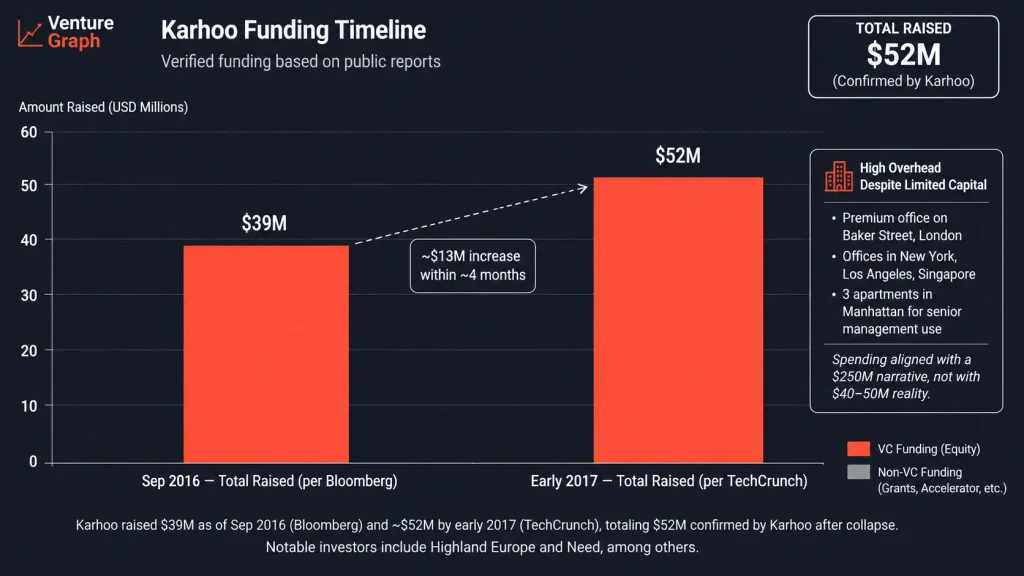
The clearest verified account of what Karhoo actually raised comes from two places: internal financial documents reviewed by Bloomberg, which showed the company had raised $39 million as of September 2016, and a later administrators’ report cited by TechCrunch, which put the figure closer to $52 million a number Karhoo itself confirmed after the collapse, explicitly denying it had ever raised $250 million. Neither figure is close to the number that had circulated in the press for over a year, and neither figure was corrected publicly while the company was still operating and hiring against it.
Spending Against a Smaller War Chest
Former employees also pointed to costly overhead that looked reasonable for a $250 million company and reckless for a $40–50 million one: premium office space on Baker Street in central London, additional offices in New York, Los Angeles, and Singapore, and most pointedly three apartments rented in Manhattan for senior management’s personal use during business trips. The company defended the apartments as cheaper than repeated hotel stays for traveling executives, but the optics compounded a growing sense among staff that spending wasn’t matched to reality.
By September and October 2016, the strain was visible operationally: Karhoo temporarily shut down its Tel Aviv R&D operation after being unable to pay local staff, according to an internal memo reported by Sky News at the time.
4.THE COLLAPSE
The Final Weeks
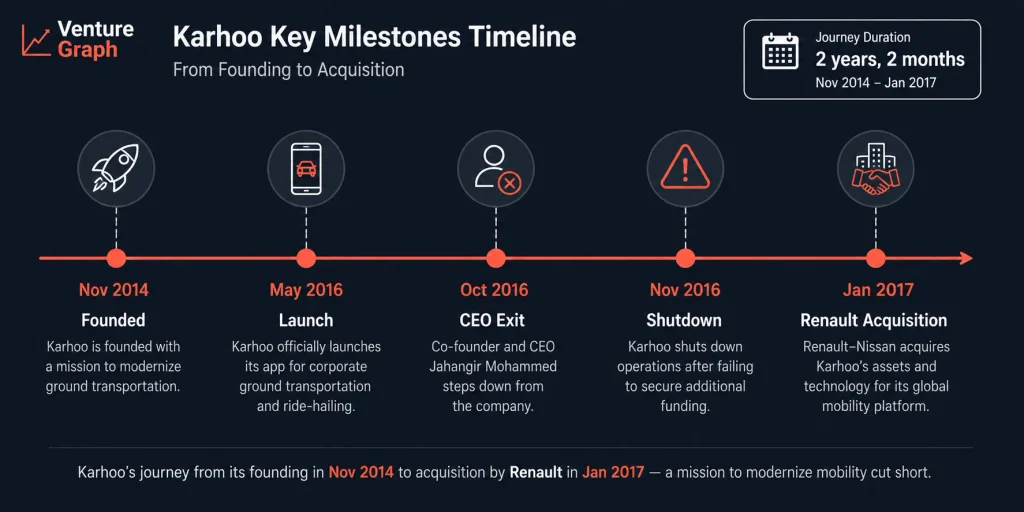
In late October 2016, Daniel Ishag stepped down as CEO, alongside his cousin David Ishag, who had served as chairman. Operational leadership passed to employees Boris Pilichowski and Nicolas Andine as the company searched for an emergency funding round large enough to keep it solvent. Ishag was reportedly in Singapore attempting to close new investment in the company’s final days.
It didn’t come together. On November 11, 2016, Karhoo announced it was shutting down its service, citing an inability to raise further funding. Staff were told the company’s account held roughly $10,000 not enough to cover the previous month’s payroll, let alone severance. The following day, Karhoo Limited and Karhoo Technologies Ltd formally entered administration, a UK insolvency process in which independent administrators take control of an insolvent company to protect creditors and attempt to sell its assets. Paul Cooper and Paul Appleton of David Rubin & Partners were appointed as joint administrators.
The Damage
The shutdown cost roughly 100 jobs in the UK and a similar number across the company’s other offices around 200 people in total, many of whom went unpaid for their final month of work and received no severance. Administrators reported strong buyer interest almost immediately, fielding bids from 30 to 40 interested parties for Karhoo’s remaining assets: its booking platform, its patents, and its contracts with taxi and private-hire fleets.
The Sale
Two months later, in January 2017, those assets were sold to Flit Technologies, a new company formed by former Karhoo staff Pilichowski and Andine, backed by RCI Bank and Services the financial arm of French automaker Renault. Reported terms were stark relative to the $250 million once claimed for the original company: roughly $1 million total (split between the asset purchase and a contribution toward paying creditors), alongside a commitment of $15 million in further investment to relaunch the business under Renault’s backing.
Which is, in a sense, the cleanest evidence for why Karhoo failed the first time but didn’t need to stay failed: the relaunched Karhoo survives today as a B2B booking platform for licensed taxi and private-hire fleets under Renault Group’s mobility strategy a far more conservative, revenue-model-first version of the original consumer-facing pitch.
5.THE VERDICT: WHY DID KARHOO REALLY FAIL?
Pulling the timeline apart, why Karhoo failed comes down to five compounding factors rather than one single cause.
- An unverified funding figure became load-bearing. Once $250 million was in the press, it shaped hiring, spending, and investor expectations even though the company’s actual cash position was a fraction of that. Nobody inside or outside the company corrected the record until it collapsed.
- Growth spending outran real revenue. Free rides and promo codes are a standard acquisition tactic, but Karhoo ran them at a pace suited to a war chest it didn’t have. Over two years, the company generated approximately $1 million in net revenue, according to internal records reviewed by Bloomberg a rounding error against its burn.
- Promo abuse went largely unchecked. Fraudulent use of free-ride codes turned a marketing cost into an open-ended liability, compounding the cash problem rather than building durable, paying users.
- Spending patterns didn’t match the real balance sheet. Premium offices across five cities and personal-use Manhattan apartments made sense for a $250 million company. Karhoo was operating with roughly a sixth of that.
- The B2B marketplace model needed time Karhoo didn’t have. Aggregating existing fleets rather than owning drivers was a genuinely lower-capital approach to ride-hailing but it still required enough runway to prove out fleet partnerships and rider habits before the money ran out, and Karhoo spent that runway on the wrong things.
6.HOW THIS PROBLEM IS SOLVED TODAY
The specific failure mode here a startup’s funding claims outrunning verifiable reality is harder to sustain publicly today than it was in 2015–2016. Platforms like Crunchbase and PitchBook now track funding rounds with far more granularity and cross-reference company disclosures against investor filings, making a gap as large as Karhoo’s harder to leave uncorrected for a year. Later-stage rounds increasingly involve formal audited financials as a condition of investment, particularly from institutional investors who got burned on unverified metrics during the 2015–2016 ride-hailing funding wave.
The B2B fleet-aggregation model Karhoo pioneered has also matured under steadier ownership. Karhoo’s own successor company, rebuilt under Renault’s RCI Bank and Services, now operates as a conservatively funded platform connecting brands, airlines, and hotel groups to licensed taxi and private-hire fleets without the consumer-subsidy burn rate that sank the original business. Established players like Curb in the U.S. and FreeNow (backed by BMW and Mercedes-Benz’s joint mobility venture) run similar fleet-aggregation models today, generally funded by strategic automotive or transport-industry backers rather than pure growth-stage venture capital chasing rapid consumer acquisition.
On the promo-fraud side, ride-hailing and delivery platforms have since built dedicated fraud-detection infrastructure device fingerprinting, behavioral analysis, and stricter code-redemption limits specifically because Karhoo-era abuse of referral and promo systems became an industry-wide, well-documented cost center rather than a one-off problem.
KEY LESSONS FOR FOUNDERS & INVESTORS
A funding number you can’t fully substantiate is a liability, not an asset. If your company’s public narrative outruns your actual bank balance, every hiring decision, spending decision, and investor conversation built on that narrative compounds the eventual reckoning.
Growth subsidies need a ceiling tied to real cash, not reported cash. Free-ride and promo-code strategies work when they’re sized to actual runway. Sizing them to a headline figure instead of a bank statement is how eighteen months of runway disappears in six.
Unchecked promo abuse is a cash leak, not a marketing cost. Fraud detection on growth incentives isn’t optional infrastructure it’s the difference between paying to acquire real users and paying strangers to farm your discount codes.
Spending should track your actual balance sheet, not your press coverage. Five-city office footprints and executive perks calibrated to a $250 million story, on a $40–50 million balance, accelerate collapse rather than signal strength.
A lower-capital business model still needs enough runway to prove itself. Karhoo’s asset-light, fleet-partnership approach to ride-hailing wasn’t the wrong idea Renault’s backers thought it was worth relaunching. It failed the first time because the company burned its actual runway on the wrong priorities before the model had time to work.
FAQ — PEOPLE ALSO ASK
Q: Why did Karhoo fail? A: Karhoo failed because it spent at a pace suited to the $250 million it publicly claimed to have raised, while its actual funding according to internal financial documents was closer to $39–52 million. Combined with heavy, fraud-prone free-ride promotions and only about $1 million in net revenue over two years, the company’s burn rate outpaced its real cash position and it ran out of money by November 2016.
Q: What happened to Daniel Ishag after Karhoo collapsed? A: Ishag stepped down as CEO in late October 2016, shortly before the company’s shutdown, and was reportedly in Singapore attempting to secure emergency funding when the collapse was announced. He sent staff an email apologizing for the company’s failure and its impact on employees, though he did not respond to later media requests for comment.
Q: Could Karhoo have survived? A: Possibly, with a smaller, more disciplined spending base matched to its real funding rather than its reported funding. The underlying B2B fleet-aggregation model was viable enough that Renault’s financial arm backed a relaunch of the same platform under Flit Technologies just two months after the shutdown suggesting the idea, not the model, needed correcting.
Q: What lessons can entrepreneurs learn from Karhoo’s failure? A: The core lesson is that spending should track your actual balance sheet, not your public funding narrative. Karhoo’s growth tactics, office footprint, and hiring pace were calibrated to a $250 million story rather than its real cash position, and that gap combined with unchecked promo-code fraud is what accelerated its collapse.
Q: How much did Karhoo actually raise, and why is the figure disputed? A: The widely reported figure was $250 million, from a Financial Times story published with the company’s cooperation. After the collapse, internal financial documents reviewed by Bloomberg showed roughly $39 million raised as of September 2016, and an administrators’ report cited by TechCrunch put the total closer to $52 million a number Karhoo itself later confirmed while explicitly denying the $250 million figure.
BUSINESS GLOSSARY
Burn rate — The speed at which a company spends its cash reserves, usually measured per month. Karhoo’s spending behaved like a company with a $250 million burn rate while its actual funding was closer to $40–50 million.
Administration — A UK insolvency process where independent administrators take control of a financially distressed company to protect creditors and attempt to sell its assets, rather than liquidating it outright. Karhoo Limited entered administration on November 12, 2016.
B2B marketplace model — A platform that connects businesses to each other (in Karhoo’s case, taxi fleets to riders and corporate partners) rather than selling directly to consumers, typically earning revenue through commission or subscription fees.
Net revenue — The actual income a company keeps after subtracting discounts, refunds, and promotional costs as opposed to gross bookings or transaction volume, which can look impressive while net revenue stays tiny. Karhoo generated roughly $1 million in net revenue over two years.
Runway — How long a company can operate before it runs out of cash, based on its current burn rate. Karhoo’s runway was shorter than its hiring and spending assumed, because those assumptions were built on the unverified $250 million figure.
Down round / distressed sale — A funding round or acquisition priced well below a company’s earlier valuation or funding claims. Karhoo’s assets sold for roughly $1 million plus a $15 million investment commitment a fraction of the $250 million once associated with the company.
Fleet aggregation — A model where a platform connects riders to existing third-party vehicle operators (taxis, private-hire fleets) rather than recruiting and managing its own driver network, lowering the platform’s direct labor and vehicle costs.
CONCLUSION
Summed up, why Karhoo failed has less to do with a bad idea and more to do with bad discipline: it didn’t fail because its idea was bad a lower-capital, fleet-partnership approach to ride-hailing was credible enough that Renault’s financial arm relaunched the same platform within months. It failed because its spending, hiring, and growth tactics were built on a funding figure the company itself couldn’t substantiate, and nobody corrected the gap before the cash ran out.
Want more startup collapses broken down like this one? Subscribe to Venture Graph for a new business failure case study, sourced and fact-checked, delivered to your inbox and follow @venturegraphofficial for the short-form breakdown of this story and dozens of others.




[…] how other hyped FinTech darlings handled – or mishandled – regulatory heat before the money ran […]
[…] Why Karhoo Failed: Inside the $250M Taxi App That Collapsed in 2016 […]