


At 1:30 AM on August 10, 2015, the inboxes of 400 employees simultaneously lit up with a catastrophic message. While most of the workforce slept, an email arrived from CEO Maren Kate Donovan announcing that the startup was ceasing all operations immediately. The sudden termination sent shockwaves through the technology industry, leaving observers desperate to understand the rapid implosion.
If you are wondering why did Zirtual fail, the answer lies in a fatal structural shift. Zirtual collapsed because it drastically miscalculated the financial impact of converting 400 independent contractors into full-time employees. Combined with a lack of internal financial oversight, this created an unsustainable burn rate that drained cash reserves before a final funding round could close.
This comprehensive business case study unpacks the dramatic collapse. We analyze the startup’s inception, its aggressive scaling phase, the regulatory pressures that triggered a fatal business model pivot, and the systemic financial blindness that caused this infamous overnight collapse.
Article Summary Zirtual was a fast-growing startup that matched busy professionals with remote assistants. In 2015, the company tried to switch its 400 workers from independent contractors to full-time employees to avoid potential legal trouble. This change caused their daily expenses to skyrocket. Because the leadership outsourced their financial tracking, they didn’t realize they were completely running out of money until it was too late. This forced them to shut down and fire all 400 employees overnight via a single email. Read on to learn exactly how their business model broke, why the cash ran out, and how modern startups solve these issues today.
Table of Contents
BACKGROUND & CONTEXT
The origins of the company stem from a distinct operational gap in the market for busy professionals and early-stage entrepreneurs. Before the proliferation of highly structured gig-economy platforms, delegating administrative tasks was remarkably inefficient. Founders either had to navigate the unreliability of offshore hiring boards or bear the immense overhead of a full-time, in-office executive assistant.
Maren Kate Donovan originally developed the core business model in 2010 during a four-month incubator program at The Founder Institute. Having previously launched a social marketing firm powered by remote college students and offshore workers, she deeply understood the complexities of delegation. Her vision for the new enterprise was simple but ambitious: bridge the gap between overwhelmed executives and highly competent, United States-based administrative talent.
Officially launching in 2011, the company positioned itself as a premium matchmaking service. Clients would pay a monthly subscription fee-starting around $99 per month-to be paired with a dedicated “ZA” (Zirtual Assistant). These assistants handled a vast array of logistical hurdles, including complex inbox management, rigorous calendar scheduling, travel arrangements, and preliminary market research.
| Service Model | Talent Location | Cost Structure | Reliability |
| Traditional Executive Assistant | Domestic / In-office | High (Salary + Benefits) | High |
| Offshore Freelance Boards | International | Low (Hourly) | Variable / Low |
| Zirtual (Early Model) | Domestic / Remote | Medium (Subscription) | High (Dedicated ZA) |
Unlike generalized freelance platforms where clients constantly cycled through unknown workers, the startup promised consistency. A client worked directly with one dedicated assistant, fostering a relationship built on trust and highly personalized institutional knowledge.
In the beginning, operations were remarkably lean. The leadership team bootstrapped the platform from day one, relying entirely on early customer revenue to fund operations. Because they functioned as a services marketplace rather than a capital-intensive software platform, they did not initially require massive infusions of venture capital. Demand surged rapidly through organic word-of-mouth marketing, forcing the company into an invite-only model simply to manage the overwhelming influx of new clients.
THE RISE
As early traction accelerated, the leadership team transitioned from bootstrapping to raising external capital, cementing their status as a rising star in the technology sector. The company secured early validation in January 2013 by closing a seed funding round backed by prominent investors, including Zappos founder Tony Hsieh, the VegasTechFund, and the Mayfield Fund.
Over successive financing events, the enterprise ultimately raised a total of $5.5 million. This capital injection transformed the operational landscape of the business. Moving away from a hand-to-mouth existence, the founders rapidly expanded the workforce to capture the overwhelming market demand.
| Funding Date | Amount Raised | Funding Type | Key Investors |
| January 2013 | $2,000,000 | Seed Round | Tony Hsieh, VegasTechFund, Mayfield |
| October 2014 | $250,000 | Debt Financing | TenOneTen Ventures, Melo7 Tech |
| December 2014 | $2,000,000 | Convertible Note | Jason Calacanis, Structure Capital |
| Mid-2015 | $1,250,000 | Debt Financing | Various |
The growth metrics appeared extraordinary to outside observers and the media. At its peak, the platform employed roughly 400 individuals scattered across 39 different states. Financially, the operation achieved an impressive milestone, reaching approximately $1 million in Monthly Recurring Revenue (MRR), which equated to a $12 million annual revenue run rate.
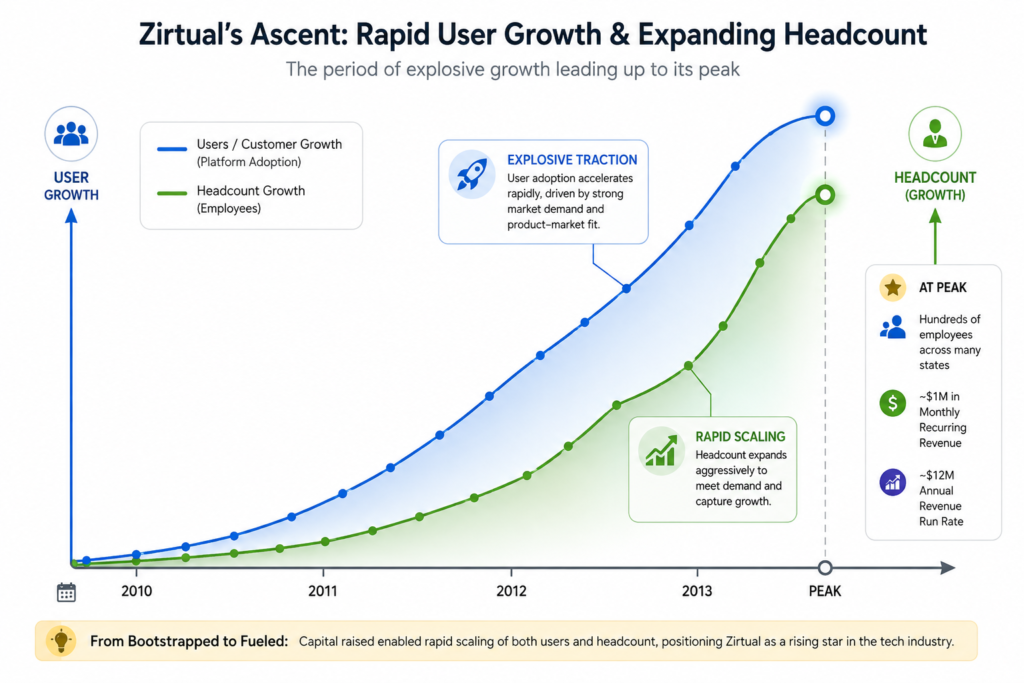
This exceptional top-line growth generated a wave of favorable media coverage. Donovan became a celebrated voice in the entrepreneurial community, frequently sharing insights on productivity, scaling remote organizations, and escaping traditional corporate structures. The enterprise was widely regarded as a triumph of the sharing economy, often mentioned in the same breath as industry titans reshaping consumer behavior.
The public narrative presented a frictionless ascent. Clients praised the seamless integration of remote assistants into their daily workflows, while the media lauded the company for providing flexible, reliable income for hundreds of domestic workers. However, beneath the veneer of rapid customer acquisition and glowing press, fundamental unit economic pressures were quietly building, masking systemic vulnerabilities that would soon challenge the business model.
THE CRACKS APPEAR
The fatal structural flaws began to manifest when the company altered its core labor strategy. Initially, the business hired virtual assistants as 1099 independent contractors. However, as the on-demand gig economy faced intense regulatory scrutiny regarding worker misclassification, the leadership team grew highly concerned. They feared potential lawsuits or fines from the Department of Labor based on a strict 20-point test outlined by the IRS.
In an attempt to avoid regulatory wrath, leadership decided to transition their vast contractor base into W-2 employees, complete with benefits. While this shift was applauded culturally, it completely devastated the company’s unit economics. The cost of payroll, insurance, and benefits aggressively compressed margins. Industry competitors analyzing the public numbers noted that the average revenue per assistant around $25,000, was entirely unsustainable relative to the newly inflated overhead.
Despite these shifting dynamics, leadership remained blind to the impending financial crisis. Instead of building a robust internal finance team to navigate this complex transition, the founders utilized an outsourced CFO service, Keating Consulting Group, led by Ryan Keating. This decision created a disastrous disconnect between the operational reality of the business and its executive financial reporting.
Much like the spectacular Zano drone failure, where ambitious public metrics became completely detached from a startup’s internal capabilities, Zirtual’s leadership lost their grip on the company’s true financial health.
Furthermore, the founders were battling severe impostor syndrome. Donovan later admitted to having a “blue collared chip on my shoulder,” noting that instead of asking for help or demonstrating vulnerability with investors, she isolated herself. She felt overwhelming pressure to maintain the facade of a Silicon Valley tech darling, choosing to navigate the financial discrepancies without deeply integrating her board or investors.
The disconnect between revenue and expenses rapidly metastasized. By the summer of 2015, the burn rate the amount of cash spent exceeding the cash earned had ballooned to a couple hundred thousand dollars a month. The executive team did not fully comprehend the gravity of the cash hemorrhage until it was entirely unmanageable. They were operating a low-margin services business with the bloated cost structure of a heavily funded software enterprise, setting the stage for an unprecedented disaster.
THE COLLAPSE
The final sequence of the Zirtual collapse unfolded with staggering velocity. By early August 2015, the company’s cash reserves were practically nonexistent. Facing an impending mid-month payroll that they simply could not fulfill, the executive team initiated a desperate, last-minute race to secure an emergency bridge round of venture funding.
For a brief moment, a financial rescue appeared possible. However, due to the company’s deteriorating margins and an overall softening in their summer growth metrics, the prospective investors abruptly pulled out at the eleventh hour. The lifeline was severed. The leadership team, advised by their legal counsel, was left with no option but to halt operations immediately to ensure the remaining capital could cover the final legal obligations to employees.
The execution of this shutdown became infamous for its harsh abruptness. On Monday, August 10, 2015, at approximately 1:30 AM, Donovan sent a mass email to the entire 400-person workforce and the client base. “It is with an incredibly heavy heart that I have to send this message,” she wrote, stating that due to “market circumstances and financial constraints,” the company was pausing all operations effective immediately.
The immediate consequences were chaotic. Employees woke up to find they no longer had jobs, health insurance, or a clear timeline for their final paychecks. Clients were suddenly stripped of the assistants managing their entire operational lives. The company immediately deleted its social media accounts and went completely silent, fueling widespread media outrage.
Within days of the shutdown, Wil Schroter, CEO of the platform Startups.co, negotiated a rapid deal to acquire the company’s assets. While this rescue allowed the service to eventually resume operations under new ownership, it did not reverse the termination of the original 400 employees. Most were forced to scramble for new employment, with many transitioning to freelance contracts directly with their former clients just to survive the fallout.
[IMAGE SUGGESTION: A close-up of a smartphone displaying a late-night email notification, representing the abrupt firing of 400 employees. — ALT text: An illustration of a late-night email showing why did Zirtual fail]
THE VERDICT: WHY DID THEY REALLY FAIL?
To understand exactly why did Zirtual fail, one must look beyond the dramatic late-night email and analyze the systemic operational breakdowns. The collapse was not caused by a lack of market demand; rather, it was a textbook case of mismanaged hyper-growth.
- Catastrophic Margin Compression: The decision to transition 400 workers from independent contractors to W-2 employees was the fatal catalyst. The leadership team implemented this massive structural shift without accurately modeling the second-order financial effects. The additional costs of benefits, payroll taxes, and compliance completely destroyed the company’s previously slim profit margins.
- Outsourced Financial Blindness: Managing a $12 million run-rate company with hundreds of employees requires rigorous, real-time internal financial modeling. By relying entirely on an outsourced CFO firm, the executive team created a critical blind spot. They failed to recognize that their monthly burn rate had escalated to lethal levels until the cash reserves were essentially empty.
- The Venture Capital Mismatch: A heavily human-capital-intensive services agency operates on fundamentally different economics than a high-margin software business. Raising venture capital incentivized the leadership to prioritize rapid scaling over sustainable unit economics, distorting their operational priorities.
- Leadership Isolation and Impostor Syndrome: When the financials began to unravel, the CEO felt immense pressure to maintain a facade of success. Driven by fear of judgment in the startup ecosystem, leadership hid the depth of the crisis from mentors and investors until it was entirely too late to execute a controlled pivot.
HOW THIS PROBLEM IS SOLVED TODAY
The modern landscape for virtual assistant platforms and remote labor management has evolved significantly to mitigate the exact vulnerabilities that caused the Zirtual collapse. Today, companies scale distributed workforces using vastly superior financial technologies and restructured labor models.
First, the regulatory and compliance burden of hiring remote workers is now managed by robust Employer of Record (EOR) platforms like Deel and Remote. These technologies allow startups to compliantly hire full-time workers globally without carrying the massive administrative overhead that crippled earlier startups.
Furthermore, the specific virtual assistant industry has largely embraced the necessity of global labor arbitrage or highly specialized AI integrations to maintain margins. Modern competitors rely on sophisticated software to augment their human assistants, dramatically increasing the revenue-per-employee metric that doomed earlier iterations.
| Operational Challenge | 2015 Approach | Modern Solution (2026) |
| Worker Classification | Manual W-2 Conversion | EOR Platforms (Deel, Remote) |
| Financial Oversight | Outsourced Accounting Firm | Real-time Fractional CFO Software (Abacum) |
| Margin Expansion | Hiring More Humans | AI-Augmented Task Delegation |
Financial visibility has also been revolutionized. Startups no longer rely solely on outsourced accounting firms delivering delayed spreadsheet updates. The proliferation of real-time fractional CFO software and advanced cash-flow dashboards forces founders to confront their burn rate continuously.
Interestingly, the remnants of the failed startup have participated directly in this modern evolution. In 2023, PennSpring Capital acquired the rehabilitated brand from Startups.com. In 2024, PennSpring officially acquired Double, integrating its proprietary AI delegation technology directly into the legacy platform, ensuring the modern iteration possesses the structural margins the original founders fundamentally lacked.
KEY LESSONS FOR FOUNDERS & INVESTORS
- Service businesses are rarely venture-backable. Raising capital forces aggressive growth expectations. If your product relies on human labor rather than scalable code, injecting venture capital can easily break your unit economics by prioritizing headcount over profitability.
- Never outsource your financial pulse. While an outsourced CFO or accounting firm is fine for early bookkeeping, a CEO must possess a granular, intuitive understanding of the company’s cash flow. Delegating the responsibility of understanding your burn rate is a dereliction of executive duty.
- Model the second-order effects of structural pivots. Shifting from a 1099 contractor model to a W-2 employee model changes the entire DNA of a business. Founders must rigorously stress-test major operational changes against extreme financial scenarios before implementation.
- Vulnerability is a survival mechanism. Falling victim to impostor syndrome isolates leaders from the exact people who can help them navigate crises. Hiding financial deterioration from investors out of pride ensures that when the crash happens, it happens catastrophically.
FAQ — PEOPLE ALSO ASK
Q: Why did Zirtual fail? A: The primary reason why did Zirtual fail was a fatal mismanagement of finances during a rapid transition from a 1099 contractor model to a W-2 employee model. This structural change destroyed their profit margins, generating a massive burn rate that leadership failed to accurately monitor before cash reserves ran dry.
Q: What happened to Maren Kate Donovan afterward? A: After the intense media fallout, Maren Kate Donovan committed to studying operational excellence and finance to correct her previous blind spots. She eventually became the Managing Partner at AVRA Talent Partners, a recruiting agency, and later founded Adios, a logistics and reuse startup, actively applying the harsh lessons of her early failure.
Q: Could Zirtual have survived? A: Yes, if the executive team had maintained rigorous internal financial oversight instead of relying entirely on an outsourced CFO. Had they accurately forecasted the margin compression, they could have proactively raised prices, controlled their headcount expansion, or executed a bridge round of funding months before the absolute depletion of their cash reserves.
Q: What lessons can entrepreneurs learn from Zirtual? A: Entrepreneurs must deeply understand that scaling a human-powered services business is fundamentally different from scaling software. The primary lesson is that founders must personally own their financial metrics, maintain transparent communication with investors during crises, and refuse to let impostor syndrome prevent them from asking for help.
Q: How did relying on an outsourced CFO contribute to the collapse? A: By delegating financial strategy to Keating Consulting Group, the internal executive team lost their intuitive grip on the company’s daily cash flow. This structural blind spot meant leadership did not realize their burn rate had reached lethal levels until they literally could not make the next payroll.
BUSINESS GLOSSARY
- Burn Rate — The speed at which a startup spends its available venture capital before generating positive cash flow, representing the difference between monthly revenue and monthly expenses.
- W-2 Employee — A standard employment classification in the United States where the employer withholds taxes from the worker’s paycheck and typically provides benefits like health insurance.
- 1099 Contractor — An independent worker who provides services to a company without being an official employee, thereby saving the company money on benefits, insurance, and payroll taxes.
- Monthly Recurring Revenue (MRR) — The predictable total of subscription-based revenue a business expects to receive every single month.
- Outsourced CFO — A third-party financial consultant or firm hired to manage a company’s high-level strategy and accounting, rather than hiring a full-time, in-house executive.
- Bridge Round — A small, emergency phase of venture capital funding designed to sustain a startup’s operations just long enough to reach its next major financing event or achieve profitability.
CLOSING CTA
The overnight implosion of this virtual assistant pioneer proves that immense top-line revenue and glowing press mean absolutely nothing if a company’s fundamental unit economics are broken. For founders, the ultimate lesson is clear: you can outsource your administrative tasks, but you can never outsource the responsibility of understanding your own cash flow.




[…] Why Did Zirtual Fail? The 2015 Virtual Assistant Implosion Exposed […]
[…] Why Did Zirtual Fail? The 2015 Virtual Assistant Implosion Exposed […]
[…] Related read: Why Did Zirtual Fail? The 2015 Virtual Assistant Implosion Exposed A fatal miscalculation of the cost of converting 400 contractors to full-time employees, combined […]