
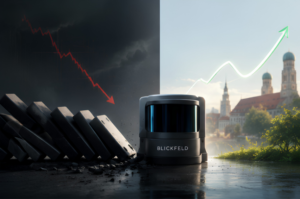
In June 2024, a Munich sensor company that had spent seven years building toward the self-driving car boom filed for insolvency and most retrospectives of that year’s startup casualties stopped the story right there. The Blickfeld LiDAR startup insolvency happened because a slower-than-expected rollout of autonomous vehicle technology left the company without enough revenue to sustain its cash burn, forcing it into German court-supervised restructuring in June 2024, but unlike most companies on 2024’s failure lists, Blickfeld didn’t shut down. It restructured, kept operating, pivoted its focus toward security and traffic-monitoring applications, and was ultimately acquired outright by a Nasdaq-listed security company in early 2026.
This piece covers why Blickfeld’s cash ran out despite genuine technical credibility and blue-chip investors, exactly how German insolvency-in-self-administration worked in its case, what the company looks like today under new ownership, and why so many other LiDAR startups hit the same wall around the same time.
At a glance:
- Company: Blickfeld GmbH
- Founded: 2017, Munich, Germany
- Founders: Mathias Müller, Florian Petit, Rolf Wojtech
- Total raised: approximately €45 million (German press) — PitchBook-sourced reporting cites $68 million, likely including a separate €15M EIB loan
- Insolvency filed: June 2024 (self-administration)
- Exited insolvency: January 2025
- Acquired by: Senstar Technologies (Nasdaq: SNT), deal closed February 2026, for €10.4 million cash plus €1 million in earnouts
Table of Contents
BACKGROUND & CONTEXT
Three Engineers Betting on Self-Driving Cars
Blickfeld was founded in Munich in 2017 by Mathias Müller, Florian Petit, and Rolf Wojtech, entering a LiDAR sensor market that, at the time, looked like one of the clearest bets in autonomous vehicle technology. LiDAR laser-based distance sensing that lets a vehicle “see” its surroundings in 3D — was widely treated as essential hardware for any credible self-driving system, and dozens of well-funded startups worldwide were racing to build the version that would become the industry standard.
A Compact, Software-Forward Approach
Blickfeld’s specific angle was building compact, relatively low-cost 3D LiDAR sensors paired with perception software that converted raw laser point-cloud data into usable, structured information for its customers. That hardware-plus-software combination was the company’s core differentiator against rivals building sensors alone, and it drew serious early institutional backing.
Blue-Chip Investors Signal Confidence
Early funding came from Fluxunit (Osram’s venture arm), High-Tech Gründerfonds, Tengelmann Ventures, and Unternehmertum Venture Capital Partners, joined later by automotive supplier Continental and Bayern Kapital. Continental’s involvement in particular signaled real industry validation a Tier 1 automotive parts supplier backing a nine-person startup’s sensor technology is not a speculative bet made lightly. By the time Blickfeld had scaled into a team of roughly 46 employees, the company had positioned itself as one of Germany’s more credible LiDAR plays in a crowded global field.
THE RISE
Blickfeld’s funding built steadily over its first six years, culminating in a €15 million loan from the European Investment Bank in 2022 — a notable vote of confidence from a public institution that typically backs companies it views as strategically important to European industry. German startup press tracked Blickfeld’s cumulative raise at roughly €35 million heading into its final private round.
That final round came in December 2023: a €7.5 million growth financing round led by New Future Capital, joined by existing backers UVC Partners, Bayern Kapital, Continental, High-Tech Gründerfonds, and Tengelmann Ventures, pushing the company’s total funding past €45 million. PitchBook-sourced figures cited in other coverage put Blickfeld’s total funding closer to $68 million a gap likely explained by whether the separate EIB loan is counted alongside equity raised, since debt and equity are tracked differently across data sources.
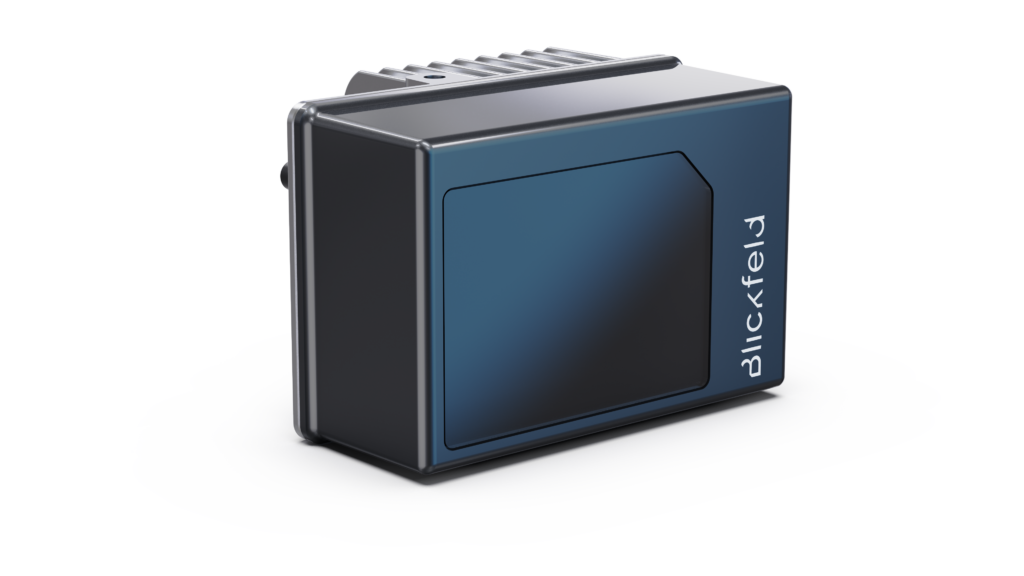
Through 2022 and 2023, Blickfeld also expanded its commercial footprint beyond pure automotive R&D, building out use cases in security perimeter monitoring, industrial automation, and traffic analysis – markets with faster paths to revenue than waiting for automakers to finalize autonomous vehicle production timelines. That diversification would later turn out to be the exact thread Senstar picked up when it eventually acquired the company.
THE CRACKS APPEAR
Why This Autonomous Driving Startup Insolvency Happened
Blickfeld’s core original bet, that autonomous vehicles would reach meaningful production volume on a timeline matching its investors’ expectations didn’t materialize. Widespread industry reporting throughout 2023 and 2024 documented fierce competition within the LiDAR sector combined with slower-than-expected adoption of autonomous vehicle technology globally, leaving multiple well-funded sensor makers with far less revenue than their cash burn required.
Part of a Wider Wave of LiDAR Startup Failures in 2024
This wasn’t a story of one company’s mismanagement. Ibeo Automotive Systems, a Hamburg-based LiDAR maker with over 400 employees, filed for the same kind of self-administered insolvency back in September 2022, citing an inability to secure further growth financing. By 2025, U.S.-listed LiDAR company Luminar Technologies filed for Chapter 11 bankruptcy as part of a court-supervised sale process for its own LiDAR business. Blickfeld’s insolvency sits inside a documented pattern across the entire LiDAR category, not an isolated failure of execution.
Public Confidence vs. Private Cash Position
As late as December 2023 — just six months before the insolvency filing, Blickfeld was publicly announcing a fresh €7.5 million raise that pushed its total funding past €45 million, a signal of continued investor confidence. That the company needed court protection barely two quarters later illustrates how quickly a hardware startup’s cash position can deteriorate once revenue timelines slip, even with active investor support and a recently closed round on the books.
What “Self-Administration” Actually Meant
Under German insolvency law, Insolvenz in Eigenverwaltung (self-administration) allows a company’s existing management to remain in charge of daily operations under court supervision, rather than handing control to an external administrator, with the explicit goal of restructuring the business rather than liquidating it. Attorney Rolf G. Pohlmann of the Munich firm Pohlmann Hofmann was appointed as the court-supervising custodian overseeing Blickfeld’s proceedings — a structural detail that distinguishes this case from a straightforward liquidation from the outset.
THE COLLAPSE: How the Blickfeld LiDAR Startup Insolvency Unfolded
The Filing
Blickfeld formally entered self-administered insolvency proceedings in June 2024, confirmed publicly through German startup-news outlet deutsche-startups.de, which reported the LiDAR sensor maker was insolvent despite its recent financing success. The filing placed Blickfeld among a wave of Munich-area startups that hit insolvency in the same quarter, reflecting a broader tightening across German venture-backed hardware companies that year.
Restructuring, Not Shutdown
Unlike a liquidation, Blickfeld’s operations continued throughout the proceedings under its existing management team, with the court-appointed custodian working alongside the founders to restructure the business rather than wind it down. The explicit goal consistent with how self-administration proceedings function under German law was to preserve the company, its technology, and as many jobs as possible while resolving its debt position.
January 2025: A Successful Exit
By January 2025, Blickfeld had been formally released from its self-administration proceedings, and the insolvency process was closed a genuine restructuring success relative to how these filings often end. The company continued operating afterward, having shed enough financial burden through the process to keep functioning as an independent business for another year.
December 2025 – February 2026: The Blickfeld Senstar Acquisition
On December 9, 2025, Senstar Technologies Corporation (Nasdaq: SNT), a physical-security and access-control technology company, announced an agreement to acquire Blickfeld GmbH. The deal closed on February 17, 2026, funded with €10.4 million in cash plus €1 million in performance-based earnouts — a price that reflects a steep markdown from the roughly €45 million previously invested in the company, but a real, completed sale to an operating business rather than a bankruptcy liquidation. Senstar’s CEO Fabien Haubert stated the acquisition brought co-founder Dr. Mathias Müller and the Blickfeld team into Senstar directly, indicating the founding team remained with the company through the transition rather than departing at the point of insolvency.
THE VERDICT: WHY DID THEY REALLY NEARLY FAIL?
- The company’s core market moved slower than its funding timeline assumed. Blickfeld raised and spent against an expectation of autonomous vehicle adoption that, industry-wide, arrived years behind the pace investors and founders had priced in.
- Automotive-grade hardware sales cycles are brutally long. Selling sensors into Tier 1 automotive supply chains even with a supplier like Continental as an investor involves multi-year qualification processes that don’t align well with venture-backed cash-runway timelines.
- The company was operating in a structurally overcrowded category. With more than 100 competitors tracked in the LiDAR space, including well-capitalized players like Ouster, Innoviz, and Hesai, differentiation alone wasn’t enough to guarantee revenue at the volume needed to sustain the burn.
- A late-stage pivot toward security and industrial applications came after the cash crisis, not ahead of it. Blickfeld’s diversification beyond pure automotive use cases was real and ultimately valuable — it’s what made the company attractive to Senstar but it matured only after insolvency forced the reckoning, rather than preventing it.
- The 2023–2024 venture funding environment offered less room for a bridge round than prior years would have. A company with Blickfeld’s technical credibility and investor base might have secured emergency bridge financing more easily in 2021; by 2024, the broader capital-markets tightening across deep-tech and hardware startups made that option far less available.
WHERE BLICKFELD IS TODAY
Blickfeld continues to operate under its own name and brand out of Munich, now as a wholly owned subsidiary of Senstar Technologies rather than an independent company. Co-founder Dr. Mathias Müller joined Senstar directly as part of the acquisition, alongside the core Blickfeld team — meaning the founding technical leadership stayed with the product rather than exiting at the point of insolvency or sale.
The product focus has shifted decisively away from Blickfeld’s original automotive ambitions. Its current lineup centers on 3D security LiDAR sensors for perimeter intrusion detection, alongside continued work in volume monitoring and traffic-analysis applications — the exact diversified use cases the company had been building out since 2021, now fully repositioned as its core business rather than a side bet. Senstar has described the acquisition as extending its own physical-security product line, combining its existing perimeter intrusion detection systems and video management software with Blickfeld’s sensor hardware.
Senstar’s own public statements frame the deal as broadening its addressable market into a security-LiDAR segment it projects will grow more than 20%, with plans to cross-sell Blickfeld’s sensors to Senstar’s existing security customers rather than the reverse.
Blickfeld also continues to appear at industry trade shows under its own brand — the company was scheduled to exhibit at Intertraffic Amsterdam in March 2026, presenting LiDAR-based traffic solutions, less than a month after the Senstar deal formally closed. For a company that filed for insolvency less than two years earlier, that continuity — same name, same Munich base, same founding technologist, functioning product line — is a meaningfully different ending than the outright shutdowns that make up most of this site’s case studies.
KEY LESSONS FOR FOUNDERS & INVESTORS
Diversify your end markets before a cash crisis forces you to. Blickfeld’s security and industrial applications proved to be its most valuable asset in the end, but the company only leaned into them fully after insolvency — doing so earlier might have prevented the filing altogether.
A recent funding round isn’t a guarantee of runway. Blickfeld closed a €7.5 million raise just six months before filing for insolvency — a reminder that burn rate and revenue timing matter more than a fundraise’s headline size.
Restructuring frameworks like self-administration can be a genuine second chance, not just a euphemism for failure. Blickfeld’s exit from proceedings within seven months, followed by over a year of continued independent operation, shows the mechanism can work as designed when a business is fundamentally viable.
Betting your entire model on one industry’s adoption timeline is a concentrated risk. Automotive autonomous-vehicle adoption moved years slower than most 2017-era LiDAR startups underwrote — a lesson relevant to any founder building hardware for a single, still-emerging end market.
A distressed sale to an operating strategic buyer is a meaningfully better outcome than liquidation. Even at a steep markdown from total capital raised, Senstar’s acquisition preserved the technology, the team, and continued commercial operations — outcomes total shutdown would have destroyed entirely.
FAQ — PEOPLE ALSO ASK
Q: Why did Blickfeld file for insolvency? A: The Blickfeld LiDAR startup insolvency happened primarily because global adoption of autonomous vehicle technology moved far slower than the company’s funding and cash-burn timeline assumed. Fierce competition across the broader LiDAR sector compounded the problem, leaving revenue well short of what was needed to sustain operations by mid-2024.
Q: Did Blickfeld shut down? A: No — Blickfeld entered self-administered insolvency in June 2024 but continued operating throughout the process under its existing management, formally exiting the proceedings in January 2025. The company kept functioning as an independent business for over a year afterward before being acquired.
Q: Could Blickfeld have avoided insolvency altogether? A: Possibly, if its diversification into security and industrial applications had scaled earlier relative to its automotive-focused cash burn that pivot is ultimately what made the company valuable enough for Senstar to acquire. A deeper bridge round in early 2024 might also have bought time, though the broader 2023–2024 hardware-funding environment made that a harder ask than in prior years.
Q: What lessons can entrepreneurs learn from the Blickfeld case? A: The clearest lesson is that dependence on a single, slow-moving end market — in this case, automotive autonomous-vehicle adoption — is a concentrated risk that can outlast even genuinely strong technology and blue-chip investor backing. Diversifying revenue streams before a cash crisis, not during one, is the difference between restructuring from strength and restructuring from desperation.
Q: Why are so many LiDAR startups struggling? A: Blickfeld’s insolvency sits inside a well-documented, sector-wide pattern — Ibeo Automotive Systems filed for the same kind of self-administered insolvency in 2022, Quanergy went bankrupt in 2023, and Luminar Technologies filed Chapter 11 in 2025. Slower-than-expected autonomous vehicle adoption combined with an overcrowded field of over 100 competing LiDAR companies has left even well-funded players without enough near-term revenue to sustain their spending.
BUSINESS GLOSSARY
Self-administration (Eigenverwaltung) — A German insolvency process that lets a company’s existing management stay in control of operations under court supervision while restructuring debt, aimed at preserving the business rather than liquidating it; Blickfeld used this exact mechanism in 2024.
Distressed acquisition — When a company is bought at a steep discount to the capital it previously raised, typically because it’s operating under financial strain; Senstar’s €10.4 million purchase of Blickfeld against ~€45 million raised is a clear example.
Cash burn / runway — How quickly a company spends its available capital, and how long that capital lasts before running out; Blickfeld’s runway shortened faster than its revenue could catch up, despite a fresh raise just months before its filing.
Bridge financing — Short-term funding meant to keep a company operating between larger investment rounds or through a temporary crisis; the absence of an available bridge round in early 2024 was a contributing factor in Blickfeld’s insolvency filing.
Tier 1 supplier — In automotive terms, a company that sells components or systems directly to vehicle manufacturers; Continental’s investment in Blickfeld represented interest from exactly this tier of the industry.
Earnout — A portion of an acquisition’s purchase price paid contingent on the acquired business hitting specific future performance targets; €1 million of Senstar’s Blickfeld deal was structured this way.
Point cloud — The raw 3D data output of a LiDAR sensor — a dense set of individual distance measurements that perception software like Blickfeld’s converts into usable, structured information about the surrounding environment.
Blickfeld’s story doesn’t end the way most Venture Graph case studies do — there’s no total collapse, no liquidation, no founders walking away with nothing. What it shows instead is how close a genuinely credible, well-funded startup can come to the edge, and what it takes to pull back from it: diversified revenue, a functioning restructuring process, and a buyer willing to pay for real technology even at a steep discount.
Every Venture Graph case study follows a different path through the same territory — big promises, real money, and a moment where the story could have gone either way. If Blickfeld’s near-collapse got you thinking about how differently these stories can end, [Luxe Valet Failure: How a $75M On-Demand Parking Startup Collapsed (2013–2017)] is the next one worth reading. For the next breakdown as soon as it’s published, follow @venturegraphofficial or subscribe below.



[…] Blickfeld LiDAR Startup Insolvency 2024: From Crisis to a Surprising Comeback […]
[…] stories like this one? Venture Graph breaks down a new startup collapse every week (INTERNAL LINK: Blickfeld LiDAR Startup Insolvency 2024: From Crisis to a Surprising Comeback) the real numbers, the real timeline, and the specific decisions that mattered. Follow Venture […]
[…] this kind of case study is useful to you, browse more startup collapses in our hardware-startup failure archive, or follow Venture Graph on [@venturegraphofficial] for a new failure breakdown, funding story, or […]