


In the summer of 2015, a Luxe valet in a blue windbreaker could be standing on a San Francisco curb, key fob in hand, ready to run your car to a garage three blocks away — all summoned from an app, like hailing an Uber for your parking space. Two years later, the app was gone, the door-to-door service had been shut off city by city, and what remained of the company had been quietly folded into Volvo Cars. The Luxe valet failure came down to one brutal math problem: the company was paying real, W-2 human valets to run cars through some of America’s most expensive real estate, and no amount of app-store polish could make that arithmetic work at consumer prices.
This piece traces Luxe from its 2013 founding through its $75.5 million in venture funding, its nine-city expansion, its quiet retreat, and its 2017 sale to Volvo and pulls out what the “Uber for X” playbook still gets wrong when the underlying service is delivered by paid human labor rather than app-connected freelancers.
AT A GLANCE
- Founded: 2013, San Francisco, by Curtis Lee and Craig Martin
- Total funding raised: $75.5 million over five rounds (Redpoint Ventures, Venrock, Lightspeed Venture Partners, GV, Hertz, and others)
- Peak footprint: 9 U.S. cities (2015)
- Outcome: Acquired by Volvo Cars, September 2017, for undisclosed terms
- Core failure: Labor-intensive service pricing that never covered its own delivery cost
Table of Contents
BACKGROUND & CONTEXT
Two Zynga Colleagues and a Parking Problem
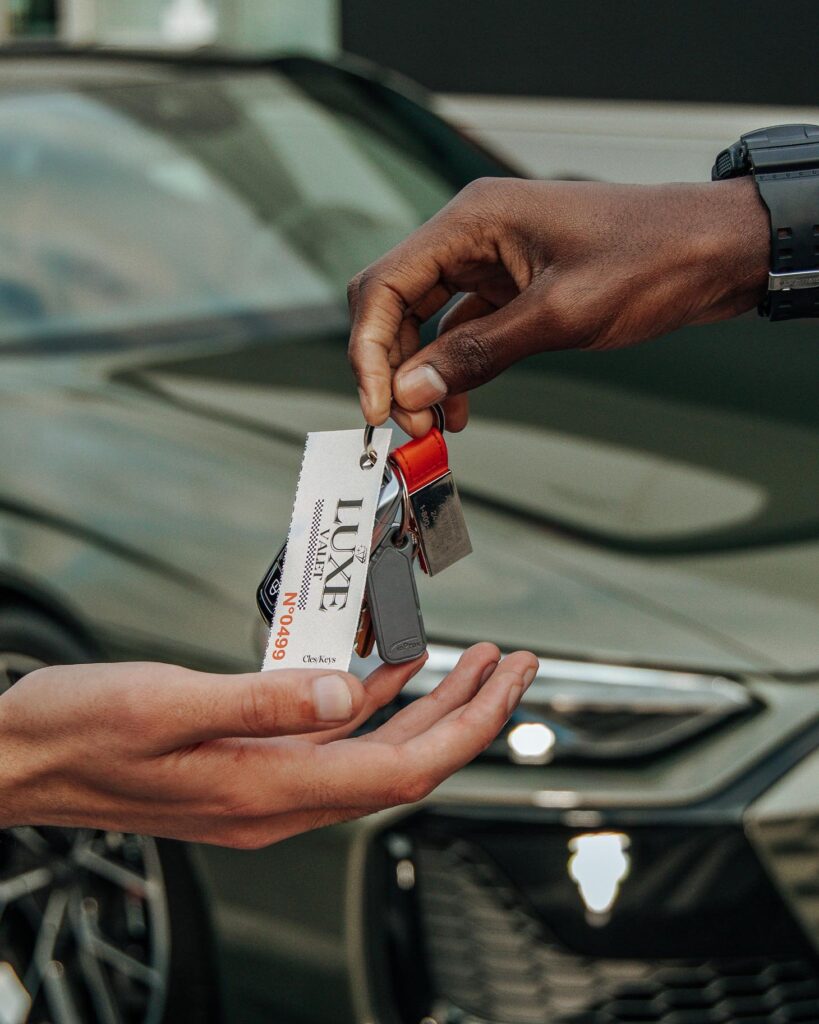
Luxe was founded in San Francisco in 2013 by Curtis Lee and Craig Martin, former colleagues at Zynga, operating initially under the corporate name 5ecret 5tar Inc. The pitch was straightforward: urban parking was scarce, expensive, and miserable to search for, and a smartphone could fix the coordination problem the same way it had fixed hailing a cab. Users would open the app, drop a pin, and a uniformed valet reachable within minutes would take the car away to a partner garage and return it on request.
The app publicly launched in October 2014, and the company built its early team from a recognizable Bay Area bench: engineers and operators pulled from Tesla, Google, Yahoo, Zynga, and Groupon. That pedigree mattered to early backers, who were still riding high on Uber and Lyft’s early growth curves and looking for the next “on-demand” category to fund.
Early Traction and the First Big Check
Growth in the first year was real by the metrics investors cared about most: month-over-month usage climbing roughly 30 percent, and roughly 18x annual growth in its first full year of operation, according to the company’s own Series B announcement. That kind of curve even from a small base was enough to draw serious institutional money almost immediately, setting up the funding story covered in the next section.
What the early traction numbers didn’t show, and what wouldn’t become visible to outsiders for another two years, was the cost structure sitting underneath every one of those rides: a human valet, paid by the hour, running a car through city traffic to a garage that itself charged rent. Growth was compounding. So was the cost of delivering it.
THE RISE
The Series A and the Land Grab
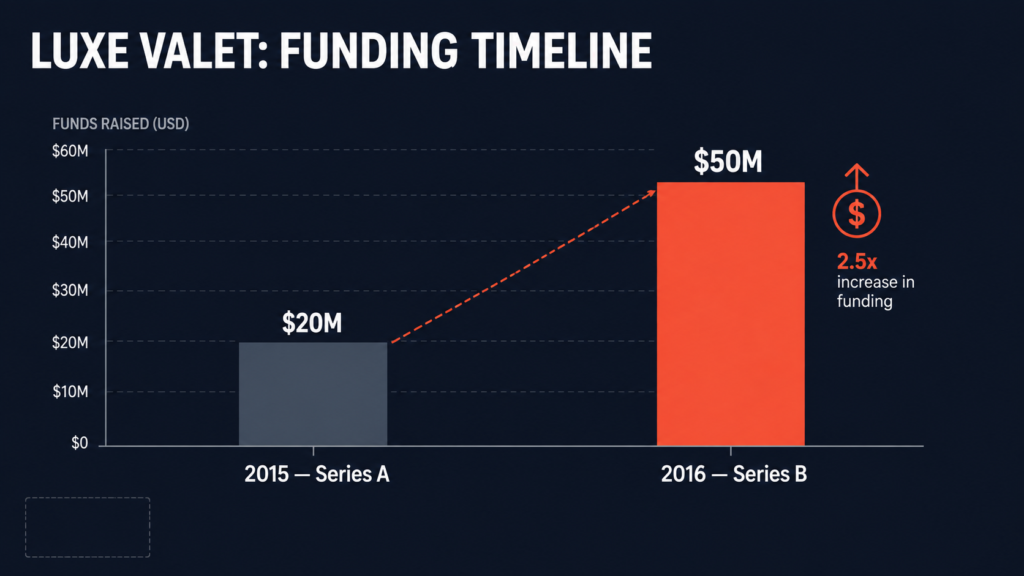
In February 2015, roughly six months after its official launch, Luxe closed a $20 million Series A, co-led by Redpoint Ventures and Venrock, with participation from Lightspeed Venture Partners, Data Collective, BoxGroup, and Winklevoss Capital. At the time, the service was live only in San Francisco and Los Angeles and was still iPhone-only the round was as much a bet on the category as on Luxe’s existing footprint.
That capital fueled an aggressive land grab. Within roughly twelve months, Luxe expanded from two markets to nine: San Francisco, Los Angeles, Seattle, Austin, Chicago, New York, plus short-lived launches in Philadelphia and Boston, with a Washington, D.C. rollout announced but never actually operationalized. Luxe’s Philadelphia launch was celebrated with an event featuring Mayor Michael Nutter and a three-hour open bar the kind of splashy civic launch that photographs well and burns cash fast.
Hertz Writes the Big Check
In April 2016, Luxe announced a $50 million Series B led by Hertz, the rental car giant, with Redpoint and Venrock returning. Hertz CEO John Tague joined Luxe’s board as part of the deal, and the round brought total funding to roughly $75 million. Redpoint partner Ryan Sarver framed the bet publicly at the time, arguing Luxe combined “an amazing habit-forming product” with the right market and leadership — the standard growth-stage validation language of the era.
By this point, at least one investor was reportedly valuing the company at more than $100 million, per Axios reporting, though Luxe never disclosed an official valuation figure alongside the round, so treat that figure as investor-sourced reporting rather than a confirmed valuation.
On paper, Luxe looked like the category leader: the most cities, the biggest brand-name investor, and a strategic partner — Hertz — whose entire business depended on solving exactly the parking-and-fleet-logistics problem Luxe claimed to be solving.
THE CRACKS APPEAR
The Public Story vs. the Unit Economics
Publicly, 2015 and early 2016 was expansion season. Privately, the nine-city footprint was already buckling under a problem that no amount of app polish could fix: unit economics — the profit or loss generated by a single transaction, once every cost of delivering it is counted. Every Luxe pickup required a real person, on payroll, physically present near the customer, able to drive, park, and later retrieve a car, often in a city where garage space itself rented for hundreds of dollars a month.
That’s fundamentally different from Uber’s model, where drivers supply their own vehicle, insurance, and idle-time cost, and the marketplace simply connects supply to demand. Luxe’s valets were W-2 employees, not independent contractors dispatched from an app — which meant Luxe carried the full weight of payroll taxes, workers’ comp, scheduling, and idle labor cost between jobs. Every uncalled-for valet standing on a corner between requests was a cost the company ate directly.
The Corporate-User Trap
Luxe’s own leadership later described the underlying tension candidly: corporate commuters who used Luxe five days a week were the most reliable revenue, but if a parking space only turned over twice in a day — dropped off in the morning, picked up at night — Luxe struggled to cover the cost of holding that spot at all. Growing the casual side of the business (dinners, weekend trips, one-off events) could improve spot turnover, but it required more valets on standby, which pushed labor costs up in exactly the cities where labor was already the most expensive line item.
The First Retreats
The strain surfaced publicly in December 2015, when Luxe shut down its Philadelphia and Boston operations — barely four months after the champagne-and-mayor launch in Philly — while insisting its core business remained “healthy” and that New York was profitable. The Washington, D.C. launch, announced months earlier, never happened at all.
Around the same time, Luxe began quietly phasing out phone-based customer support, a move that put it directly at odds with a category where, as one rival valet-startup CEO put it in a public comment, customers hand over “their most prized possession after their home” and expect a live person if something goes wrong. That single operational choice — cutting phone support to save cost — became an early, visible symptom of a company trying to trim overhead in a business where trust was the product.
THE COLLAPSE
2017: The Retreat Becomes a Rout
By December 2017, Luxe had trimmed its live markets down to just San Francisco, New York, and Chicago, having already shuttered Seattle and “paused” both Los Angeles and Austin earlier that year, laying off city-level staff and some central operations employees, including customer service reps, in the process. Co-founder and CEO Curtis Lee framed the contraction as discipline, telling Axios the company had “tens of millions of dollars in the bank” and that its door-to-door service was “profitable” once local city costs — but not centralized headquarters and marketing costs — were counted.
That framing mattered: a business that’s only profitable before corporate overhead isn’t profitable at all in any sense investors ultimately care about, and by late 2017 Luxe was signaling exactly that gap.
Killing the Core Product
The more decisive break came earlier that year. In late April 2017, Luxe emailed San Francisco customers announcing it would end door-to-door valet service entirely after May 25, 2017, promising a vaguely described “new service” for that summer instead — one built around staffed valet stands and direct garage drop-off rather than on-demand pickup anywhere in the city. Within days, the company confirmed the shutdown applied to every remaining city, not just San Francisco: the original “summon a valet anywhere” product that had defined Luxe for three years was over.
The Sale to Volvo
On September 8, 2017, Volvo Cars announced it had acquired Luxe. Terms were not disclosed. Volvo picked up Luxe’s team, technology, and remaining assets — framed publicly as a move to support Volvo’s own connected-car and delivery ambitions rather than a rescue of Luxe’s original valet business, which was already dead by the time the deal closed. Trade press had also reported Uber in acquihire talks for Luxe’s engineering team a few months earlier, in June 2017, though that deal did not materialize; Volvo ultimately closed the transaction instead.
Luxe’s total lifetime funding is consistently reported at $75–75.5 million across SiliconANGLE, Crunchbase-sourced reporting, and founder Curtis Lee’s own later public interviews a figure worth stating plainly here, since some outside summaries cite a lower $30 million figure instead. That lower number doesn’t match any documented funding round; it more likely reflects a specific burn estimate or partial tranche than Luxe’s total lifetime capital raised. This piece treats $75.5 million as the well-documented total, and flags the $30 million figure as unconfirmed by comparison.
THE VERDICT: WHY DID THEY REALLY FAIL?
- Labor-intensive delivery in a marketplace-priced category. Luxe built a W-2 workforce to deliver a service priced like a lightweight app subscription. Every valet on the payroll was a fixed cost regardless of how many cars actually needed parking that hour — the opposite of the flexible, contractor-supplied capacity that made Uber’s model work.
- Real estate costs stacked on top of labor costs. Every car had to sit somewhere, and urban garage space was itself expensive and often leased at market rates. Luxe was effectively paying twice for the same scarcity problem it was trying to monetize.
- Expansion outran unit economics. Growing from two cities to nine within a year generated headline growth numbers attractive to investors, but multiplied the exact cost structure that was already unproven at the smaller scale — scaling a losing formula faster doesn’t fix it.
- The corporate-commuter revenue base was structurally weak. Reliable five-day-a-week users generated predictable revenue but low spot turnover, meaning Luxe often covered the full daily cost of a parking space with revenue from only two transactions on it.
- Cost-cutting eroded the trust the product depended on. Phasing out live phone support to save money undercut the one thing customers were explicitly paying for: confidence that a stranger driving away with their car was fully accountable and reachable.
HOW THIS PROBLEM IS SOLVED TODAY
The core failure point — labor-heavy, human-delivered logistics priced for consumer-app economics — hasn’t gone away as a category risk, but the businesses that have survived in adjacent spaces have solved for it differently than Luxe did.
Airport and event valet operators, such as ABM Industries’ parking and mobility division, have largely kept the human-valet model but attached it to high-density, high-turnover locations — airports, stadiums, hospitals — where a single lot generates dozens of transactions per staffed valet per shift, rather than the scattered street-corner pickups Luxe was coordinating across an entire city.
App-based parking marketplaces that avoid labor entirely, like SpotHero and ParkWhiz, sidestepped Luxe’s core cost problem by connecting drivers directly to existing garage inventory rather than employing valets to move cars themselves. They function closer to a true marketplace — asset-light, commission-based — than Luxe’s model ever did.
Gig-economy classification has also tightened materially since 2017. Regulatory and legal pressure on worker classification (including California’s AB5 law and related litigation across the on-demand economy) has made the “cheap flexible labor” assumption underlying many 2014–2016 “Uber for X” pitches far harder to rely on, whether a company uses contractors or, like Luxe, W-2 staff. Any new entrant into human-delivered on-demand services today has to underwrite labor cost and compliance risk far more rigorously at the fundraising stage than Luxe’s early backers appear to have required.
Fleet-side, Volvo’s own move into Luxe’s remaining technology reflects where much of this problem space migrated: toward connected-car logistics — remote delivery, in-trunk package drop-off, and fleet-level fueling and charging — that use software to coordinate existing dealer and fleet infrastructure rather than building a net-new, city-by-city human workforce from scratch.
KEY LESSONS FOR FOUNDERS & INVESTORS
“Uber for X” only works if X is asset-light. Uber’s model works because drivers supply their own car and absorb their own idle time. The moment a startup employs the labor directly and owns the liability, the marketplace math changes completely — model that difference before fundraising, not after.
Growth metrics can hide negative unit economics for years. Luxe’s 18x annual growth and 30% month-over-month usage were real and genuinely attractive to investors — and neither number said anything about whether each transaction made or lost money.
Cost-cutting in a trust business is self-defeating. Removing phone support to save money directly undercut the reassurance customers were paying for. In services built on trust — someone else driving your car — the cheapest possible operations are often the fastest way to lose the customer relationship.
“Profitable” needs a precise definition. Luxe’s claim of profitability excluded headquarters and marketing costs — a distinction that matters enormously to an investor deciding whether to fund another round, and one every founder should state explicitly rather than let a reporter’s headline imply otherwise.
Strategic investors bring strings, not just capital. Hertz’s $50 million round gave Luxe a board seat tied to a much larger company’s own priorities; when a strategic investor’s parent company faces its own turbulence, portfolio bets like Luxe can lose a champion inside the building with little warning.
FAQ — PEOPLE ALSO ASK
Q: Why did Luxe valet fail? A: The Luxe valet failure ultimately came down to unit economics: the company employed real, salaried valets to park cars in expensive urban markets, and the fees it could charge never consistently covered that labor and real-estate cost. Aggressive city-by-city expansion in 2015 scaled that cost problem faster than the company could fix it.
Q: What happened to Luxe’s founders after the company wound down? A: Co-founder and CEO Curtis Lee went on to become a Venture Partner at Primary Venture Partners and an active angel investor in companies including Superhuman, Persona, and Poshmark. Co-founder Craig Martin reportedly stayed on through the transition period following the 2017 Volvo deal.
Q: Could Luxe have survived if it had made different choices? A: Possibly, if it had concentrated on fewer, denser markets earlier rather than expanding to nine cities in a year, and if it had shifted toward the asset-light, garage-partnership model (the approach later used by SpotHero and ParkWhiz) before burning through most of its $75.5 million. By the time Luxe tried a stands-and-garages pivot in late 2017, it had already lost most of its cash cushion and its original product.
Q: What lessons can entrepreneurs learn from the Luxe valet failure? A: The clearest lesson is that “Uber for X” pitches only inherit Uber’s economics when the underlying labor and assets are supplied by the marketplace’s users, not employed directly by the company. Founders replicating a human-delivered service should model full unit economics — including idle labor time and real estate — before, not after, taking growth capital.
Q: Why did other on-demand valet startups like Zirx also collapse around the same time? A: Zirx, a close Luxe competitor that raised roughly $36.4 million, shut down its own consumer valet service in February 2016 after facing the identical structural problem: W-2 valet labor and urban garage costs that consumer pricing couldn’t sustain. The near-simultaneous failure of Luxe, Zirx, and smaller rivals suggests the entire on-demand valet category, not just one company’s execution, had an unworkable cost structure at consumer price points.
BUSINESS GLOSSARY
Unit economics — The revenue and cost of a single transaction, once every expense of delivering it is counted. A company can grow fast and still lose money on every unit if unit economics are negative — this was the core problem behind the Luxe valet failure.
W-2 employee — A worker directly employed by a company, with the company responsible for payroll taxes, benefits, and scheduling, as opposed to an independent contractor. Luxe’s valets were W-2 staff, which raised its fixed labor costs compared to contractor-based marketplaces.
Series A / Series B — Sequential rounds of venture funding a startup raises as it grows; Series A typically follows early product-market validation, and Series B typically funds scaling. Luxe raised a $20M Series A in 2015 and a $50M Series B in 2016.
Strategic investor — An investor, often a larger company in an adjacent industry, that funds a startup partly for financial return and partly to advance its own business interests. Hertz’s investment in Luxe was a strategic bet on parking and fleet logistics.
Acquihire — An acquisition made primarily to obtain a company’s talent and technology rather than its ongoing business or brand. Reports of Uber’s interest in Luxe in 2017 described it in acquihire terms before Volvo ultimately closed the deal.
Burn rate — The speed at which a startup spends its cash reserves before generating enough revenue (or raising more capital) to sustain itself. Luxe’s rapid nine-city expansion in 2015 significantly increased its burn rate.
Asset-light model — A business model in which a company avoids owning or directly staffing the physical infrastructure of its service, instead coordinating existing third-party assets. Later parking apps like SpotHero used an asset-light model to avoid the cost problem that defined the Luxe valet failure.
Luxe raised $75.5 million to prove that an app could fix urban parking — and proved instead that no amount of software polish offsets a cost structure built on paid human labor in expensive cities. The company that could summon a valet in minutes couldn’t summon a business model that scaled.
Want more startup failure breakdowns like this one? Explore the full Venture Graph archive of collapsed startups, filterable by industry, funding raised, and failure reason — or subscribe to get one new case study in your inbox every week, no fluff, just the receipts.