

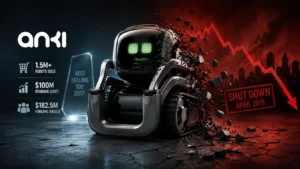
In April 2019, Anki a robotics company that had sold 1.5 million AI-powered toy robots and pulled in close to $100 million in revenue in a single year laid off its entire staff of roughly 200 people with a week’s severance and closed its doors. Why did Anki fail? Anki collapsed not from a lack of customers or bad products, but because its hardware never generated enough margin to fund itself, leaving the company permanently dependent on new investor cash and when one late-stage financing deal fell through in April 2019, there was no fallback left. Cozmo, its breakout robot, had been the best-selling toy in its category the year before. None of that was enough.
This piece traces Anki’s full arc: the Carnegie Mellon research project that became a $182.5 million-funded company, the products that made it a genuine hardware success story, the internal financial pressure building for years before anyone outside the company noticed, and the 72 hours in which it all ended. It closes with the specific business lessons this collapse still teaches founders and investors building consumer hardware today.
At a glance — Anki, Inc.
- Founded: 2010, San Francisco, by three Carnegie Mellon robotics PhD researchers
- Peak products: Anki Drive/Overdrive, Cozmo, Vector
- Total funding raised: ~$182.5M (rounded to ~$200M in some reports)
- Peak revenue: ~$100M (2017)
- Units sold: 1.5M+ robots lifetime
- Employees at shutdown: ~200
- Shut down: April 2019
- What happened to the IP: Acquired by Digital Dream Labs via bankruptcy auction, December 2019
Table of Contents
BACKGROUND & CONTEXT
Anki was founded in 2010 by Boris Sofman, Mark Palatucci, and Hanns Tappeiner, three PhD researchers out of Carnegie Mellon University’s robotics program. Their pitch was simple to say and hard to build: take genuine, research-grade robotics and artificial intelligence and put it inside products ordinary consumers would actually buy, rather than leaving the technology locked inside university labs and defense contracts. That framing consumer robotics as a mainstream category, not a novelty became the company’s identity for the next decade.
The first product, Anki Drive, was a smartphone-controlled toy racing set: small cars that used onboard AI to navigate a track, react to opponents, and even “attack” each other with virtual weapons triggered from a phone app. It looked, on the surface, like a Hot Wheels set. Underneath, the cars ran real-time collision detection and autonomous driving logic developed from the founders’ own doctoral research.
Anki Drive launched in October 2013 and made its public debut on stage at Apple’s WWDC 2013, demoed personally as an example of what the iPhone platform could enable an extraordinary launch moment for an unknown hardware startup. That visibility, paired with early venture backing, gave Anki a market gap few competitors could match: nobody else was selling research-grade AI robotics at toy-aisle prices and toy-aisle marketing budgets. The gap was real. Filling it profitably would prove to be the harder problem.
THE RISE
Anki followed Drive with Anki Overdrive (an upgraded, modular version of the racing platform) before making its defining bet: Cozmo, a small, expressive desktop robot released in 2016. Anki had hired animators from Pixar and DreamWorks to give Cozmo believable, non-verbal “personality” tilting its head, celebrating wins, sulking after losses on top of genuine computer-vision and facial-recognition capability. It launched at $179.99 and became, by multiple retailer accounts including Amazon US, the best-selling toy of 2017.
That year, Anki’s revenue approached $100 million, a figure the company publicly expected to exceed in 2018. It had, by its own count, shipped over 1.5 million robots across its product lines. In October 2018, Anki launched its most ambitious device yet: Vector, a $249 always-on, cloud-connected successor to Cozmo built to live permanently on a desk rather than be packed away after play. Vector went on to win a CES 2019 Innovation Award in the Robotics and Drones category timing that, in hindsight, sat uncomfortably close to the company’s final months.
Underpinning all of it was serious venture capital: Anki raised $182.5 million across multiple rounds (rounded to “around $200M” in several reports) from investors including Andreessen Horowitz, Index Ventures, Two Sigma Ventures, J.P. Morgan, and C4 Ventures, among others. By every visible external measure product awards, sales rankings, revenue growth, marquee investors Anki looked, in late 2018, like one of the very few consumer robotics companies that had actually cracked the category.
THE CRACKS APPEAR
The public story and the internal financial story had already diverged well before 2019. The core problem was structural: consumer hardware at a sub-$300 price point carries brutal margins once you account for the bill of materials (the total cost of every physical component in a product) for a device doing real-time computer vision, autonomous navigation, and cloud-connected AI. Even at genuine bestseller volumes, Cozmo and Vector left very little gross margin the money left over per unit after direct production costs to cover Anki’s substantial R&D, animation, and software teams.
Those teams were not cheap by design. Anki had deliberately hired animation talent from Pixar and DreamWorks to build Cozmo and Vector’s “emotional AI,” a decision that produced genuinely differentiated, award-winning products and a cost structure closer to a game studio than a toy company. Layered on top of that was the toy industry’s structural seasonality: a business that does a large share of annual sales in a single holiday quarter has a much harder time smoothing out cash flow than a subscription business does.
There were also visible warning signs by mid-2018, if you knew where to look. In September 2018, board member and Andreessen Horowitz co-founder Marc Andreessen resigned his director role as the company underwent a recapitalization a restructuring of a company’s financing terms, often signaling that existing investors are adjusting the cap table to reflect a lower valuation or changed risk picture rather than injecting fresh growth capital. Separately, by March 30, 2018, Anki had taken a loan from Silicon Valley Bank secured against its own intellectual property patents, trademarks, and product designs pledged as collateral. That structure meant Anki’s core IP, not just its balance sheet, was now directly exposed if the company couldn’t repay.
None of this was visible to Cozmo and Vector customers, who kept buying a genuinely well-reviewed product. It was, however, exactly the kind of quiet balance-sheet stress that tends to precede a sudden hardware-company collapse rather than a slow, visible decline.
THE COLLAPSE
The end, when it came, was fast. Anki had reportedly been pursuing acquisition or strategic-investment interest from companies including Microsoft, Amazon, and Comcast through early 2019, alongside a separate late-stage financing round. In the final week of April 2019, according to CEO Boris Sofman, a financing deal with a strategic investor fell through “at the last minute,” and none of the acquisition conversations converted into a deal either.
With no financing bridge left, Anki announced on April 29, 2019 that it was shutting down, effective that Wednesday, laying off essentially its entire staff of just under 200 people with one week of severance. Sofman’s message to employees emphasized that the company had shipped millions of units and built technology it was proud of, but that it could not continue “without significant funding to support a hardware and software business” the exact bind hardware startups face when a single blocked funding round removes their entire runway at once.
The aftermath moved through the normal mechanics of a hardware-company bankruptcy. Anki formally ceased operations and moved toward bankruptcy proceedings in the following weeks. On June 3, 2019, IP law firm Fish & Richardson filed a lien against the company for unpaid patent and trademark prosecution fees one of several creditor claims that surfaced once the shutdown became public. By December 2019, Anki’s full IP portfolio 45 utility patents, trademarks, customer data, and product blueprints for Cozmo, Vector, and Overdrive was sold at a Hilco Streambank bankruptcy auction to Pittsburgh-based edtech company Digital Dream Labs, which continues to sell and support relaunched versions of the robots today.
THE VERDICT: WHY DID THEY REALLY FAIL?
- Hardware margins that never scaled, even at real volume. Anki hit genuine bestseller numbers — 1.5 million units, ~$100M revenue — and the unit economics still weren’t strong enough to fund the next generation of R&D without outside capital. Scale alone didn’t fix the core margin problem.
- A financing structure with no fallback. Anki’s survival depended on the next round closing, every time. When one late-stage deal fell through in April 2019, the company had no bridge — the model itself made every funding round existential rather than merely important.
- R&D costs built for a category that didn’t exist yet. Hiring Pixar- and DreamWorks-level animation talent produced genuinely superior products, but it built a cost base closer to an entertainment studio than a toy manufacturer, at a price point the toy market could bear.
- No recurring revenue to smooth the cycle. Anki sold hardware, once, largely in a holiday-heavy sales window — with none of the subscription or software revenue that could have cushioned a slow quarter or a delayed funding round.
- IP pledged as loan collateral concentrated the risk. Using patents and trademarks to secure the Silicon Valley Bank loan meant that when the company’s finances weakened, its core intellectual property not just its cash was directly exposed to creditors.
HOW THIS PROBLEM IS SOLVED TODAY
The specific trap Anki fell into brilliant hardware, thin margins, zero recurring revenue, total dependence on the next funding round is now a well-documented pattern in consumer robotics, and the industry has visibly adjusted around it. The clearest shift is toward subscription-supported hardware: Digital Dream Labs, which now owns the Cozmo and Vector IP, sells continued cloud features and support for the relaunched robots through a paid subscription rather than a single hardware sale, directly addressing the recurring-revenue gap that hurt Anki.
A parallel pattern shows up across the wider industry: companies that survived the same 2018–2019 consumer-robotics shakeout which also claimed home robot Jibo and Mayfield Robotics’ Kuri within roughly the same twelve-month window increasingly pivoted away from pure toy-market hardware sales toward education, enterprise, or services contracts with more predictable, recurring revenue, rather than competing purely on a one-time retail price point.
Investors have adjusted too. Hardware-focused venture rounds today more commonly stage funding against specific unit-economics milestones gross margin thresholds, not just sales volume rather than treating strong top-line revenue alone as evidence a hardware business is sustainable. It’s a direct, if belated, lesson from companies like Anki: revenue and popularity are not the same thing as a business model that survives a single closed door.
KEY LESSONS FOR FOUNDERS & INVESTORS
- Revenue is not the same as a sustainable business. Anki had near-$100M revenue and a bestselling product and still ran out of runway in days. Growth metrics tell you about demand, not about whether the underlying unit economics can fund the company on their own.
- Never let one deal be your entire plan B. A single “strategic investor” or acquirer walking away should not be able to end a company overnight. Build genuine alternative paths smaller bridge rounds, cost cuts, alternate buyers before you need them.
- Match your cost structure to your price ceiling. Studio-grade R&D talent produces genuinely better products, but if the market you’re selling into caps prices at $180–$250, that cost base has to be sustainable at that ceiling, not just impressive in a pitch deck.
- Build in recurring revenue before you need it, not after. A subscription, service, or software layer is far easier to add while a company is healthy than to bolt on during a cash crunch — by then, the credibility and the runway to do it well are both gone.
- Know what you’re pledging when you take secured debt. Using core IP as loan collateral can be the right call, but founders should treat it as a real bet on the company’s near-term survival, not routine financing paperwork.
FAQ — PEOPLE ALSO ASK
Q: Why did Anki fail? A: Anki failed because its hardware business never generated enough gross margin to fund itself, leaving the company permanently dependent on new financing. When a late-stage strategic investment deal fell through in April 2019, Anki had no bridge left and shut down almost immediately, laying off its roughly 200 employees.
Q: What happened to Anki’s founders after the shutdown? A: Within about two months, co-founder and CEO Boris Sofman, along with 12 other former Anki engineers, joined Waymo, where Sofman became Director of Engineering and Head of Trucking, leading the autonomous trucking program. Co-founder Hanns Tappeiner joined Apple’s Special Projects Group in August 2019. Sofman later left Waymo in 2024 to co-found robotics startup Bedrock Robotics.
Q: Could Anki have survived? A: Possibly, if it had built recurring subscription revenue earlier or secured a broader financing structure that didn’t hinge on one late-stage deal. But the underlying bill-of-materials economics of sub-$300 consumer robotics hardware made survival difficult industry-wide — rivals Jibo and Kuri collapsed within the same twelve-month window for similar structural reasons.
Q: What lessons can entrepreneurs learn from Anki’s collapse? A: The clearest lesson is that strong revenue and consumer popularity don’t guarantee survivable unit economics. Founders building hardware should build recurring revenue and a genuine financing plan B before a cash crunch forces the decision, not after.
Q: Who bought Anki’s assets, and is Cozmo still available? A: Pittsburgh-based edtech company Digital Dream Labs bought Anki’s full IP portfolio — including Cozmo, Vector, and Overdrive patents, trademarks, and blueprints — through a Hilco Streambank bankruptcy auction in December 2019, and continues to sell relaunched, subscription-supported versions of the robots today.
BUSINESS GLOSSARY
- Bill of Materials (BOM): The total cost of every physical component that goes into manufacturing one unit of a product the baseline cost a company has to beat with its retail price to have any gross margin at all.
- Gross Margin: The money left over per unit after direct production costs are subtracted from the sale price the actual cash a company has available to cover everything else it does, from salaries to R&D.
- Recapitalization: A restructuring of a company’s financing or ownership terms, often signaling that investors are resetting valuation or risk expectations rather than adding significant new growth capital.
- Bridge Round: A smaller, often urgent round of financing meant to extend a company’s runway until a larger round or a strategic event closes the kind of fallback Anki did not have in April 2019.
- Strategic Investor: An investor often a larger company that invests partly for financial return and partly for business alignment, such as future acquisition or partnership potential, which is why a collapsed strategic deal can be more damaging than a typical VC round falling through.
- IP Collateral / Lien: Using a company’s intellectual property patents, trademarks, product designs to secure a loan, meaning creditors can claim that IP if the company can’t repay, as happened with Anki’s Silicon Valley Bank loan.
- Bankruptcy Auction: A court-supervised sale of a failed company’s remaining assets to creditors or buyers, which is how Digital Dream Labs acquired Anki’s Cozmo, Vector, and Overdrive IP in December 2019.
- Hardware Startup: A company whose core product is a physical device rather than software, generally facing higher capital requirements, thinner margins, and slower iteration cycles than pure software companies the exact category of risk that defined Anki’s collapse.
12. CLOSING CTA
Anki’s collapse wasn’t a story of a bad product or a company nobody wanted it was a story of a business model that couldn’t survive a single closed door, no matter how many robots it had already sold. The lesson for anyone building physical products today is the same one Anki’s own founders carried into their next companies: revenue proves demand, not survivability.
Want more stories like this one? Venture Graph breaks down a new startup collapse every week (INTERNAL LINK: Blickfeld LiDAR Startup Insolvency 2024: From Crisis to a Surprising Comeback) the real numbers, the real timeline, and the specific decisions that mattered. Follow Venture Graph or subscribe at venturegraph.me for the next case study.



[…] Why Did Anki Fail? Inside the $182M Cozmo Robot Collapse (2019) […]