


In June 2020, forty-year-old Austin startup ScaleFactor told its remaining staff the company was suspending most of its operations. Founder Kurt Rathmann blamed Covid-19 for gutting demand. The real story, reported by Forbes weeks later, was less forgivable: the ScaleFactor failure wasn’t a pandemic casualty it was a $103 million company that had promised investors and small-business owners a working AI bookkeeper and, according to former employees and customers, never actually built one.
The short version: ScaleFactor marketed an artificial-intelligence platform that could automate bookkeeping, payroll, and tax filing for small businesses, but former employees and customers told Forbes that much of the “automated” work was done manually by in-house accountants and an outsourced firm in the Philippines, producing error-filled books that ScaleFactor blamed on Covid-19 when it finally shut down in 2020.
This piece covers ScaleFactor’s founding story, its rapid rise through four funding rounds, the internal cracks that predated the pandemic by more than a year, the collapse itself, and what the AI bookkeeping category has done differently since.
At a glance:
- Founded: 2014, Austin, Texas
- Founder: Kurt Rathmann
- Total raised: $103M+ across four rounds (2017–2019)
- Collapse announced: June 23, 2020
- Operations wound down: August 28, 2020
- Official cause: Covid-19 revenue loss
- Reported actual cause: Product never delivered on its AI claims; manual/outsourced labor stood in for automation
- Peak ARR: ~$7M (2019, per Forbes)
Table of Contents
BACKGROUND & CONTEXT: THE ROOTS OF THE SCALEFACTOR FAILURE
An Accountant’s Pitch to Silicon Valley
Kurt Rathmann wasn’t a typical founder chasing a garage-startup myth. He trained as a CPA, worked as a senior audit professional at KPMG, and later became CFO of a small communications firm, where he grew frustrated watching decisions get made on financial reports that were a month out of date. That frustration became the founding premise of ScaleFactor, which Rathmann launched in Austin in 2014.
The pitch was simple and, on paper, genuinely appealing. Small businesses hate bookkeeping. It’s tedious, it’s expensive to outsource to a human accountant, and most owners have no visibility into their numbers until a report lands weeks after the fact. ScaleFactor proposed to fix all three problems at once with software: an AI-driven platform that would plug into QuickBooks and Xero, automatically categorize transactions, generate real-time financial statements, and eventually handle payroll, bill pay, and tax prep all without a human bookkeeper in the loop.
From Idea to Product
The company didn’t ship its first real product until 2017, three years after founding, when it went through Techstars Austin’s accelerator and picked up $2.5M in early funding. That product built directly on top of QuickBooks and Xero rather than replacing them outright, positioning ScaleFactor as an intelligence layer sitting on top of accounting software small businesses already used.
The company’s marketing leaned hard into the emotional pitch rather than the technical one. Its tagline “because evenings are for family, not finances” sold a lifestyle outcome, not a feature list. That framing would later matter: it meant ScaleFactor was competing less on proven automation accuracy and more on the promise of time given back to overworked founders, a promise that’s much harder to fact-check before you’ve paid for a year of service.
By the time it left Techstars, ScaleFactor had a working wedge, a sympathetic founder story, and a genuine market gap. What it didn’t yet have was proof its AI could do the job at scale a gap venture capital was about to fund it past, rather than force it to close.
THE RISE OF AN AI BOOKKEEPING STARTUP
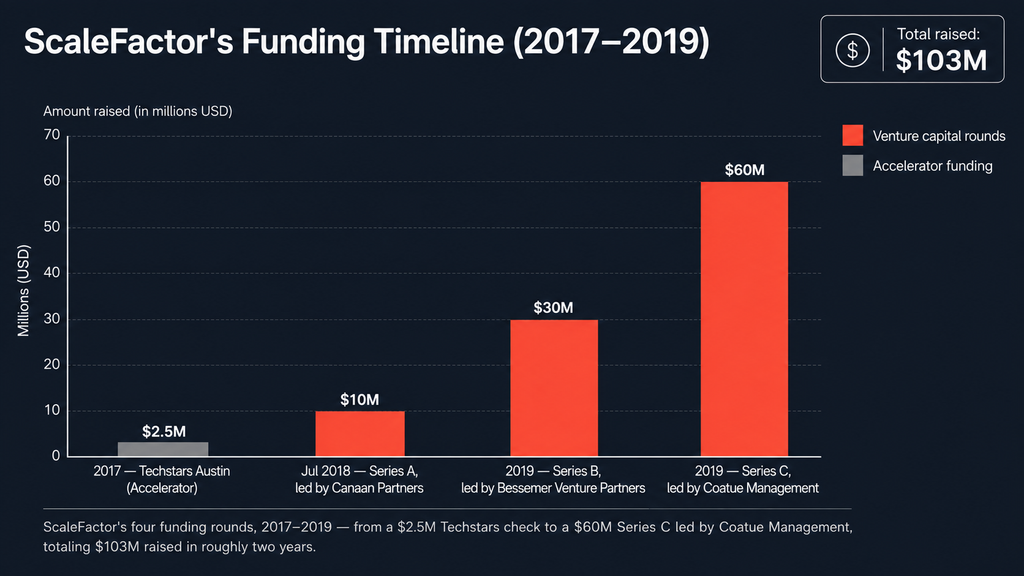
ScaleFactor’s funding history is a near-textbook case of capital arriving faster than product validation for what was, on paper, the most closely watched AI bookkeeping startup of its cohort. In July 2018, the company closed a $10M Series A, a round that multiple later reports (including G2’s) describe as led by Canaan Partners. That was quickly followed by a $30M round led by Bessemer Venture Partners, one of the most respected fintech investors in the country a name that did real work legitimizing ScaleFactor to the wider market. By 2019, the company had closed a $60M Series C led by Coatue Management, pushing total capital raised past $103M in roughly two years.
For context on how fast that was: ScaleFactor went from a $2.5M accelerator check to over $100M in venture funding in under three years a pace that assumes a product already proven at scale, not one still being figured out in-house.
The money bought ScaleFactor real market presence. It grew to roughly 100 employees at its Austin headquarters, expanded its customer base past 250 small businesses, and by 2019 reported around $7M in annual recurring revenue. Bessemer and Coatue’s involvement gave the company a halo effect common to well-funded fintech startups of the late 2010s: the assumption, widely shared by customers and press alike, that if this much smart money believed the AI worked, it probably worked.
That assumption was never independently tested by anyone outside the company before the money kept arriving. As an AI bookkeeping startup, ScaleFactor was, by every outward signal, exactly what a 2019 “disruptive fintech” was supposed to look like a technical founder with a credible origin story, tier-one VC backing, a growing customer base, and a mission statement that solved a problem nearly every small business owner recognized instantly.
THE CRACKS APPEAR: EARLY WARNING SIGNS OF THE SCALEFACTOR FAILURE
The gap between ScaleFactor’s marketing and its actual delivery mechanism is the center of the story, and it predates the pandemic by well over a year. This is where the ScaleFactor failure actually began, long before Covid-19 entered the picture. According to former employees who spoke to Forbes, the company’s AI could not reliably classify transactions or produce accurate reports on its own. To keep customers’ books current, ScaleFactor employed dozens of human accountants and bookkeepers directly out of its Austin headquarters essentially a manual data-entry operation running behind a software front end.
To handle overflow, the company contracted The Outsourced Accountant, an offshore bookkeeping firm based in the Philippines, to help process client books. One former accountant described the operation bluntly to Forbes: it functioned, in practice, like a conventional bookkeeping firm rather than a software company the defining term for this pattern is AI-washing, marketing a service as artificial intelligence when the underlying labor is substantially human.
This mattered commercially, not just ethically. Customers were paying for what they believed was real-time, automated bookkeeping a core differentiator from hiring a traditional accountant. What they got instead, according to multiple customer accounts, was monthly financial statements the same delivery cadence as a conventional bookkeeper frequently containing errors: duplicate transactions, miscategorized expenses, and missing entries. One customer told Forbes they lost $17,000 after ScaleFactor mishandled a transaction.
Internally, the strain showed up as churn and pivots rather than one clean breaking point. In June 2019, while the company was in the middle of closing further funding, employees described growing dysfunction around the gap between what sales promised and what the product could deliver. By January 2020 two months before Covid-19 reached the U.S. in force Rathmann held an all-hands meeting announcing a pivot: ScaleFactor would move away from pure software and toward a marketplace model connecting small businesses with traditional human accountants. That pivot triggered layoffs of roughly 40 employees, mostly accountants and bookkeepers, in February 2020 a month before the pandemic gave the company a more palatable public explanation for what was already underway.
THE COLLAPSE: HOW SCALEFACTOR SHUT DOWN
The pandemic didn’t cause the ScaleFactor failure it gave the company a cover story for a collapse that was already in motion. When Covid-19 hit the U.S. in March 2020, existing customers began pulling back immediately. One documented case: longtime customers Robert and Cornelia Stang balked when told their monthly contract would jump from $500 to $1,700, a pricing shift that landed just as small businesses were bracing for the worst economic shock in a decade.
By Rathmann’s own account to Forbes, Covid-19 cut the company’s $7M ARR roughly in half. In the spring of 2020, ScaleFactor’s investors met to discuss the company’s future and ultimately decided to shut it down rather than fund another pivot.
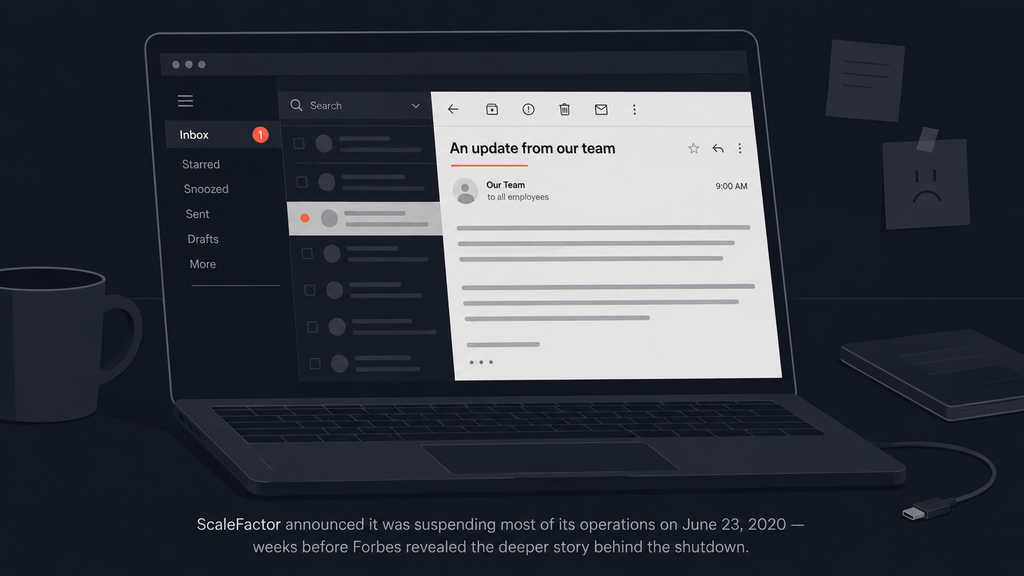
On June 23, 2020, Rathmann held a town hall with the roughly 100 remaining employees to announce that ScaleFactor shut down the majority of its operations effective August 28, 2020. Half the staff was let go that day; the rest stayed on temporarily to help transition customers before the company wound down further. In a public message, Rathmann framed the decision around the difficulty of the moment rather than the product’s track record, telling Forbes that business owners in crisis wanted “pen and paper,” not automation tools.
Less than a month later, Forbes published its investigation contradicting that framing, based on interviews with former employees and customers describing years of manual labor standing in for the promised AI. The company said it would return a portion of its remaining capital to investors but did not disclose how much. No bankruptcy filing, customer class action, or SEC enforcement action followed publicly ScaleFactor simply wound down as a private company, which is part of why, unlike Theranos, its story never became a mainstream household name despite the scale of the gap between claim and reality.
THE VERDICT: WHAT CAUSED THE SCALEFACTOR FAILURE?
- The core product never matched the core claim. ScaleFactor raised over $100M on the premise of AI-automated bookkeeping. According to former employees, the AI could not reliably perform the task on its own, and the company covered the gap with human labor the single root cause underneath every other symptom in this story.
- Growth capital arrived faster than product validation. Three tier-one rounds in under two years gave ScaleFactor headcount, marketing budget, and market credibility long before its core technology was proven at the accuracy level its pricing and pitch implied.
- The business model quietly became labor-intensive without repricing. Software companies scale because marginal cost per customer stays low. A company secretly running on human bookkeepers and an outsourced firm scales cost linearly with customers the opposite of what its valuation assumed.
- Trust-based errors compound in accounting, unlike in most software categories. A wrong recommendation in most consumer apps is an annoyance; a wrong transaction categorization is a customer’s tax filing or payroll. ScaleFactor’s error rate directly threatened the exact outcome “financial clarity” that was its entire value proposition.
- Covid-19 was a convenient, believable excuse, not the actual trigger. The pivot away from pure automation, the layoffs, and the investor discussions about winding down all predate the pandemic by weeks to months. Covid gave leadership a public narrative that didn’t require admitting the product hadn’t worked.
HOW TODAY’S AI BOOKKEEPING STARTUPS SOLVE THIS PROBLEM
The core failure behind the ScaleFactor failure claiming full automation while quietly running on human labor became a cautionary pattern every subsequent AI bookkeeping startup has had to design around directly, and the fixes since 2020 fall into two categories: honesty about the human-in-the-loop, and better underlying technology.
Human-in-the-loop is now marketed as a feature, not hidden as a liability. Platforms like Puzzle, which launched an AI Suite in 2026, explicitly built their systems around accountant sign-off rather than full autonomy the platform’s AI Close tool auto-categorizes the large majority of transactions but routes ambiguous ones to a human for review, with every change logged. Pilot took the opposite approach in 2026 by launching a genuinely autonomous “AI Accountant” tier but crucially, it sells this as a separate, cheaper product tier alongside its traditional human-bookkeeper tier, letting customers knowingly choose their risk tolerance rather than discovering the gap after the fact.
Real-time data integration replaced monthly manual reconciliation. A major driver of ScaleFactor’s error rate was reconciling data after the fact. Modern AI-native ledgers like Puzzle connect directly to Stripe, Mercury, Brex, Ramp, and Gusto, so transaction data streams in continuously rather than being batch-imported and cleaned up once a month closing the exact gap between “promised real-time” and “delivered monthly” that defined the ScaleFactor complaints.
The category still isn’t immune to the same failure pattern. Notably, Botkeeper a direct AI bookkeeping competitor built on a similar automation promise shut down in 2025 to 2026, and even human-powered incumbent Bench announced its own shutdown on December 27, 2025, before being acquired and relaunched days later by Employer.com. [INTERNAL LINK: related Venture Graph case study on Botkeeper’s collapse] The pattern ScaleFactor set in 2020 promise full automation, underdeliver, blame externalities evidently outlived the company itself, which is exactly why transparent human-in-the-loop design has become the credible middle ground the category converged on.
KEY LESSONS FOR FOUNDERS & INVESTORS
The ScaleFactor failure offers a fairly clean set of takeaways for anyone building or funding a startup in a trust-critical category.
Don’t let go-to-market outrun the technology. ScaleFactor’s marketing promised full automation years before its underlying AI could deliver it. If your product roadmap and your sales pitch are on different timelines, the gap eventually becomes a customer’s problem, then a press problem.
Marginal cost is the tell. If scaling your customer base requires scaling headcount at a similar rate, you are not running the software business your valuation assumes you’re running a services business with a software multiple, and that mismatch eventually breaks.
In trust-critical categories, accuracy is the product. Bookkeeping, health, and legal software don’t get graceful failure. A wrong number in a customer’s books isn’t a bug report it’s their tax filing. Categories like this need a higher bar for “ship it” than most SaaS.
Investor logos aren’t independent verification. Bessemer and Coatue’s involvement gave ScaleFactor legitimacy by association, but neither the raise nor the roster of investors constituted outside proof the AI worked as claimed due diligence gaps at the funding stage passed straight through to customers.
An external crisis is not obligated to be your real reason. ScaleFactor’s public Covid-19 explanation was believable precisely because it was true that the pandemic hurt revenue it just wasn’t the whole story. Watch for shutdown narratives, in any startup, that conveniently arrive right when a harder internal explanation was already due.
FAQ — PEOPLE ALSO ASK
Q: Why did ScaleFactor fail? A: The ScaleFactor failure came down to a product that never matched its marketing: the company raised over $103M promising AI-automated bookkeeping, but former employees told Forbes the “automation” was substantially performed by in-house accountants and an outsourced firm in the Philippines. That gap produced error-filled books, customer churn, and a January 2020 pivot away from pure automation months before Covid-19 gave the company a more sympathetic public explanation.
Q: What happened to Kurt Rathmann after ScaleFactor? A: Rathmann took a role as VP of Channel & Strategic Partnerships at Brex from January 2021 to June 2022, then moved into a VP of go-to-market role at Brex for Startups. He’s also listed as co-founder of a separate venture, Urban Inn, dating back to January 2019, alongside his ScaleFactor tenure.
Q: Could ScaleFactor have survived? A: Possibly, if the company had repriced or repositioned itself as a hybrid human-plus-software service earlier and more honestly which is roughly the model Kurt Rathmann’s own January 2020 pivot was attempting. By the time Covid-19 hit, that pivot was still mid-transition, and investors chose to wind the company down rather than fund another rebuild.
Q: What lessons can entrepreneurs learn from ScaleFactor? A: The clearest lesson is that marketing claims about automation need to match what the product can actually do before scaling sales the moment a company’s real cost structure (human labor) diverges from its funded story (software), the mismatch eventually surfaces through customers, not investors. It’s a caution against AI-washing: selling a human-powered service as software-driven automation.
Q: What other AI bookkeeping startups have failed since ScaleFactor? A: ScaleFactor wasn’t an isolated case. Botkeeper, a direct AI bookkeeping competitor, shut down in the 2025–2026 period, and even Bench a human-powered bookkeeping incumbent announced a shutdown on December 27, 2025, before being acquired and relaunched days later by Employer.com. Together the three companies raised over $300M combined, suggesting the trust gap ScaleFactor exposed in 2020 was a category-wide problem, not a single founder’s failure.
BUSINESS GLOSSARY
AI-washing — Marketing a product or service as AI-driven when the underlying work is substantially performed by humans. This is the central term describing what former ScaleFactor employees alleged about the company’s core product.
Annual Recurring Revenue (ARR) — The predictable revenue a subscription business expects to collect over a year from its current customers. ScaleFactor’s ARR peaked around $7M in 2019, which its investors compared against its $103M in funding when deciding whether to keep funding growth.
Series A / B / C — The sequential rounds of venture funding a startup raises as it grows, each typically larger and priced at a higher valuation than the last. ScaleFactor moved through a Series A, B, and C in roughly two years, a pace that outstripped its ability to prove its core technology.
Human-in-the-loop — A system design where automated software handles routine work but routes uncertain or high-stakes decisions to a human for review before anything is finalized. Modern AI bookkeeping platforms adopted this openly as the fix for the trust gap ScaleFactor left behind.
Churn — The rate at which customers cancel or stop paying for a service over a given period. ScaleFactor’s error-filled books drove customer churn well before Covid-19 became the company’s public explanation for its decline.
Outsourcing — Contracting a business function, like bookkeeping, to a third-party firm rather than performing it in-house. ScaleFactor’s use of a Philippines-based outsourcing firm, The Outsourced Accountant, became a key piece of evidence that its “AI” was substantially manual labor.
Runway The amount of time a startup can keep operating before it runs out of cash, given its current spending rate. ScaleFactor’s runway effectively ran out once its investors declined to fund a fourth pivot in 2020.
CONCLUSION
ScaleFactor’s core lesson isn’t that AI hype is dangerous it’s that the gap between what a product claims and what it actually delivers always surfaces eventually, and in trust-critical categories like accounting, that gap becomes someone’s tax filing before it becomes a headline.
Want the next case study before it’s published? Subscribe to Venture Graph’s newsletter for weekly startup-failure breakdowns, or follow @venturegraphofficial for the story in under 60 seconds.




[…] ScaleFactor Failure: How a $103M AI Bookkeeping Startup Collapsed […]