

In November 2015, a small Welsh drone company quietly filed for insolvency, and with it went the largest crowdfunding failure Europe had ever seen. The Zano drone Kickstarter failure happened because a small Welsh engineering firm called Torquing Group promised a palm-sized, fully autonomous selfie drone it did not yet know how to build, raised $3.6 million on the strength of a simulated demo video, then collapsed within a year after shipping almost nothing that worked. Roughly 600 partially functional units reached customers and Kickstarter’s own investigation later found only four of those went to actual backers.
This piece walks through how Zano became Kickstarter’s most-funded European project, what really broke inside Torquing Group while the public updates stayed upbeat, the specific week everything fell apart, and what crowdfunding platforms changed afterward because of it.
At a glance:
- Company: Torquing Group (product: Zano)
- Founded: ~2008, Cardiff/Newport area, Wales
- Kickstarter campaign: November 24, 2014 – January 8, 2015
- Amount raised: $3.6 million (£2,335,119) from 12,075 backers — 20x the original goal
- Collapse: Voluntary liquidation, November 2015
- Units delivered to Kickstarter backers: 4, out of roughly 15,000 pledges
Table of Contents
BACKGROUND & CONTEXT
A Defense Engineer’s Side Project
Torquing Group was a small Welsh aerospace and defense technology contractor, co-founded by engineer Ivan Reedman roughly seven years before Zano’s collapse. Reedman’s day job involved developing surveillance drone technology for a defense contractor, and it was that experience not a background in consumer electronics manufacturing that fed directly into his pitch for a consumer product. He believed the same autonomous-flight techniques used in military-grade hardware could be shrunk down into something that fit in a shirt pocket.
The Pitch: A Drone That Flies Itself
The idea he brought to Kickstarter in November 2014 was ambitious for its era: a “nano drone” called Zano that would ditch manual joystick controls entirely. Instead, it would track its operator using a Wi-Fi-linked smartphone app, avoid obstacles on its own, follow gestures, and automatically snap aerial selfies all for roughly 15 minutes of flight time per charge. Reedman’s funding target was modest by comparison: just £125,000, framed as the last push needed to move an already-flying prototype into full production.
Early Signals Looked Strong
The campaign video showed Zano hovering over pub patrons, tracking a mountain biker, and following a motocross rider’s hand gestures all polished, professional footage that made the product look market-ready. Kickstarter selected Zano as a Staff Pick, giving it front-page visibility before it had raised a single pound from the general public. That early platform endorsement, combined with the founder’s genuine aerospace credentials, is what let a £125,000 ask snowball into a European crowdfunding record within seven weeks.
THE RISE
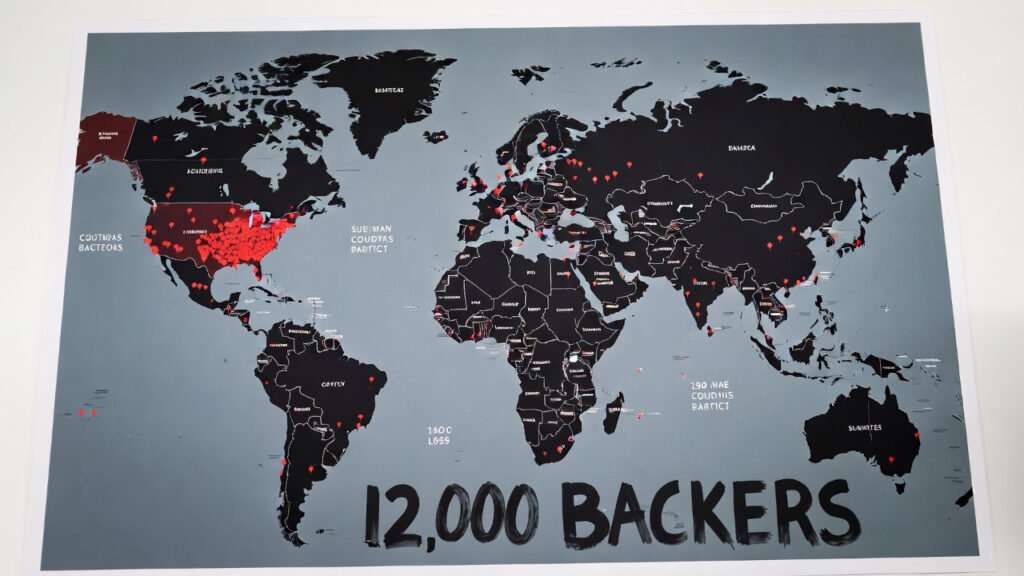
By the time the Kickstarter campaign closed on January 8, 2015, 12,075 backers had pledged £2,335,119 (about $3.6 million) — roughly 20 times Reedman’s original £125,000 target, making Zano the most-funded European project in Kickstarter’s history at that point.
Momentum didn’t stop at the campaign’s close. Days later, Torquing Group flew representatives to CES in Las Vegas, and Engadget shortlisted Zano for its Best of CES award one of just 49 nominees out of roughly 20,000 products shown at the world’s largest tech trade show that year. Months after that, Popular Science named Zano to its “Best of What’s New” list for 2015, cementing its reputation as a category-defining gadget rather than a risky crowdfunding bet.
Throughout the first half of 2015, Torquing Group kept backers engaged with a steady cadence of roughly one project update per week describing final chipsets arriving in Wales, a newly developed tiltable camera mount, and a promised shipping window of June 2015, just six months after the campaign ended. On paper, everything about Zano’s trajectory the funding multiple, the CES nod, the magazine placement, the weekly updates looked like a startup executing cleanly on a hit product. Reality inside the company was already diverging sharply from that narrative.
THE CRACKS APPEAR
The Prototype Problem
The core issue, later confirmed by an independent investigation, was that Zano’s Kickstarter video simulated capabilities the drone did not actually have at the time of filming. Under Kickstarter’s own rules, hardware and product-design campaigns are required to show a real, working prototype, no CGI, no simulated functionality, no photorealistic renderings standing in for an unbuilt product. Competitors who examined the footage closely told investigators the autonomous flight shown simply wasn’t achievable with the components and price point Torquing Group had committed to.
June 2015 Comes and Goes
The promised June 2015 shipping date passed with no drones in backers’ hands. By August, Torquing Group publicly admitted that while the hardware was largely finished, the software part responsible for the autonomous tracking, obstacle avoidance, and gesture control that had defined the pitch was not ready. This is the critical distinction between the public narrative and the private reality: backers were told this was a polish problem, when in fact the flight-control software was the entire technical premise of the product, not a finishing touch.
CES 2015: The Warning Sign Nobody Heeded
Torquing Group’s own CES booth became an early tell. Representatives set up a display but repeatedly declined to fly the drone live, offering visitors a rotating set of excuses, Wi-Fi interference at the venue, a stolen laptop containing the demo software. One competitor who examined the underlying technology at the show later described realizing the product as pitched was not achievable at all.
The BBC Visit
When the BBC visited Torquing Group’s headquarters in mid-2015 to check on production progress, its report “Zano drones struggle to achieve lift-off” surfaced the same pattern: promised functionality that wasn’t demonstrable on request, and a shipping timeline that kept sliding. Ars Technica’s own visit to the company that May found representatives promising a July 2015 shipment a date that also came and went without product.
THE COLLAPSE
The CEO Exits
On November 10, 2015, Reedman abruptly resigned from Torquing Group, posting to the company’s own backer forum that his departure was due to “personal health issues and irreconcilable differences.” He described the seven years he’d spent building the company as effectively his entire adult working life, and the loss of it as devastating. Tech press immediately read the resignation as a signal the company was in serious trouble, Ars Technica specifically wrote that Torquing appeared to be “in crisis mode and may be on the verge of collapse.”
Eight Days Later
The prediction held. On November 18, 2015, Ars Technica reported that Torquing Group had collapsed, confirmed by a bare-bones project update posted to backers stating the company could not continue and would not be delivering drones or refunds. The firm entered the UK equivalent of bankruptcy voluntary liquidation shortly after.
What Actually Shipped
Of the roughly 15,000 drones ordered across the Kickstarter campaign and subsequent pre-orders, Torquing Group had shipped only about 600 units total by the time it folded and a later independent investigation found that just four of those went to original Kickstarter backers; the rest went to customers who had placed post-campaign pre-orders. The devices that did ship were widely reported to fly poorly or not at all, missing the autonomous features that had defined the pitch entirely.
The Aftermath
Backers organized petitions demanding refunds, including one addressed somewhat implausibly to the UK Prime Minister at the time. No lawsuits against Torquing Group or its founders are known to have been filed. With the company in liquidation and no meaningful assets remaining, backers had essentially no path to recovering their money. Facing sustained public pressure over its role, Kickstarter itself commissioned journalist Mark Harris in December 2015 to independently investigate what had happened an unusual step for a platform that normally treats itself as a neutral intermediary between creators and backers.

THE VERDICT: WHY DID THEY REALLY FAIL?
- The product was pitched years ahead of the team’s actual technical capability. Reedman’s aerospace and defense background gave Zano credibility, but consumer-grade autonomous flight at a mass-manufacturable price point was a fundamentally different engineering problem than anything Torquing Group had previously shipped.
- The core campaign video misrepresented the product’s real-world state. Kickstarter’s hardware rules specifically ban simulated or CGI-enhanced demonstrations, and the independent investigation concluded Zano’s footage crossed that line showing capabilities the drone did not reliably have at the time.
- Software, not hardware, was the unsolved problem — and it was treated as an afterthought. The autonomous tracking and obstacle-avoidance software was the entire premise of Zano’s pitch, yet it remained undelivered while public updates focused on hardware milestones that made progress look further along than it was.
- Platform-level checks failed to catch it. Kickstarter had dropped mandatory project pre-vetting in June 2014, months before Zano launched, relying instead on backers to self-police rules around simulated demos a burden most backers were never equipped to carry.
- Leadership departed at the exact moment stability was needed most. Reedman’s resignation, framed publicly as a personal decision, removed the one person with both the technical authority and founder credibility to potentially steer the company through its crisis; a supplier later told investigators his exit was effectively the company’s death.
HOW THIS PROBLEM IS SOLVED TODAY
Kickstarter’s own after-action response to the Zano failure was the most direct consequence of the case. The platform’s current rules for hardware and product-design campaigns explicitly require creators to demonstrate a working prototype — not a rendering, not a simulation — and to disclose clearly whether any promised software-hardware integration has actually been built yet or still needs to be developed. Photorealistic renderings standing in for real product demonstrations are now prohibited outright, closing the exact loophole Zano’s campaign video exploited.
Kickstarter also now requires every hardware and product-design project to include a “Risks and Challenges” section, written by the creator, laying out upfront what could go wrong in manufacturing and delivery a transparency requirement that didn’t exist in its current form when Zano launched.
Beyond Kickstarter itself, the broader hardware-crowdfunding ecosystem shifted toward platforms that build in more structural vetting. Sites like Crowd Supply position themselves specifically around pre-screening hardware projects for manufacturing feasibility before they’re allowed to launch, rather than relying purely on backer skepticism after the fact. Indiegogo’s InDemand and similar late-pledge models also let campaigns continue selling only after a first production batch has actually shipped — reducing the odds that a company collects a decade’s worth of preorders on a product that’s still theoretical.
None of this makes hardware crowdfunding failure-proof. Complex physical products with software dependencies remain genuinely hard to ship on schedule even for well-funded, competent teams. What changed is narrower but real: the specific mechanism Zano used a simulated demo passed off as a working product is harder to get away with on a major platform today than it was in 2014.
KEY LESSONS FOR FOUNDERS & INVESTORS
A working prototype means working, not “almost.” If a campaign video needs any simulation, CGI, or careful editing to show a feature functioning, that feature isn’t ready to be sold yet — no matter how close the team believes it is.
Software timelines are notoriously hard to compress under funding pressure. Zano’s hardware genuinely progressed on schedule; its software the actual product differentiator did not, and no amount of hardware progress could substitute for it.
Overfunding is a liability, not just a win. Raising 20x a target multiplies manufacturing scale, expectations, and refund exposure simultaneously, all before a team has proven it can build even the funded version of the product.
Founder credibility from one domain doesn’t automatically transfer to another. Deep expertise in defense-grade drone engineering did not guarantee competence in consumer manufacturing, supply chains, or shipping a mass-market product on a fixed budget.
Leadership continuity matters most exactly when things are going wrong. The sudden departure of the one person with technical authority over the product removed any real chance of course-correcting once problems became undeniable.
Platform trust signals (staff picks, awards, press coverage) are not due diligence. CES nominations and magazine placements reflected how the pitch looked, not whether the underlying technology existed at the claimed maturity level.
FAQ — PEOPLE ALSO ASK
Q: Why did the Zano drone Kickstarter campaign fail? A: The Zano drone Kickstarter failure came down to a gap between what the campaign video showed and what Torquing Group’s engineering team could actually deliver. The autonomous flight software behind the drone’s core selling points was never finished, while the company’s public updates emphasized hardware progress that made the project look further along than it was.
Q: Was Zano actually a scam? A: An independent investigation commissioned by Kickstarter concluded Zano was not a deliberate scam, the investigator found the team made a genuine, if badly mismanaged, attempt to build the product. The report did find the campaign video was misleading about the drone’s real capabilities, which is why “scam” remains the popular framing even though intent to defraud was never established.
Q: What happened to Ivan Reedman after Zano collapsed? A: Reedman resigned from Torquing Group on November 10, 2015, eight days before the company entered liquidation, citing personal health issues and unspecified internal conflict. No public reporting has documented his subsequent career, and it remains [UNVERIFIED] whether he has founded or joined another company since.
Q: How much money did Zano raise, and did backers get anything back? A: Zano raised $3.6 million (£2,335,119) from 12,075 Kickstarter backers, against an original goal of just £125,000. With the company in liquidation and no significant remaining assets, backers had no realistic path to refunds; only a handful ever received a working drone at all.
Q: What did Kickstarter change after the Zano collapse? A: Kickstarter tightened its hardware and product-design rules to explicitly require creators to show a genuinely working prototype, banned photorealistic renderings and simulated demonstrations from campaign videos, and added a mandatory “Risks and Challenges” disclosure section all direct responses to gaps the Zano case exposed.
BUSINESS GLOSSARY
Crowdfunding overfunding — When a campaign raises significantly more than its stated goal (Zano raised roughly 20x its target), which scales manufacturing demand, logistics, and refund exposure far beyond what the original plan accounted for.
Working prototype — A physical, functioning version of a product that actually performs the features being marketed, as opposed to a rendering, mockup, or simulation. Kickstarter’s rules require hardware creators to demonstrate one before launching a campaign.
Voluntary liquidation — The UK insolvency process a company enters when its directors choose to wind it down because it can no longer pay its debts; roughly equivalent to a company voluntarily filing for bankruptcy in the US.
Staff Pick — A curatorial endorsement Kickstarter gives to select campaigns, boosting their visibility on the platform’s homepage and category pages before public funding momentum has been established.
Risks and Challenges section — A mandatory, creator-written disclosure on every Kickstarter project outlining what could realistically go wrong in delivering the product, introduced in the years following high-profile failures like Zano.
Backer — An individual who pledges money to a crowdfunding campaign in exchange for a future reward (typically the product itself), rather than equity or guaranteed returns — a legal distinction that left Zano’s backers with essentially no recourse.
Pre-vetting — A platform’s practice of manually reviewing and approving campaigns before they go live; Kickstarter dropped mandatory pre-vetting in June 2014, months before Zano launched.
Zano didn’t collapse because its founders set out to defraud 12,000 people — it collapsed because a small team oversold an unfinished product, then kept selling that story to themselves as much as to backers, until there was no runway left to close the gap. The lesson isn’t “don’t crowdfund hardware.” It’s that the gap between a demo and a shippable product is exactly where the riskiest, most expensive assumptions hide.