

In January 2013, three founders in New York launched an app that Twitter had already agreed to buy four months earlier before it had a single user. Three years later, that same app had over 200 million people watching six-second loops every day. Why did Vine failed? In short: Vine built a generation of internet stars, refused to pay them, watched Instagram copy its core feature within months, and got shut down by Twitter in 2016 once the company needed to cut costs and the creators had already left for platforms that would.
This piece traces that arc in full, the Jetsetter office where the idea was born, the four-month sprint to a $30 million acquisition, the 200-million-user peak, the 2015 meeting where 18 top creators tried to save the platform, and the October 2016 announcement that ended it. It also covers what happened to Vine’s three founders afterward, including a death that most retrospectives leave out.
AT A GLANCE
- Founded: June 2012, New York City
- Founders: Dom Hofmann, Rus Yusupov, Colin Kroll
- Acquired by: Twitter, October 2012, before public launch
- Deal size: $30 million
- Public launch: January 24, 2013
- Peak users: 200+ million monthly active users (by late 2015)
- Shutdown announced: October 27, 2016
- App discontinued: January 17, 2017
- Archive discontinued: April 2018 (partially restored by X in 2025)
Table of Contents
BACKGROUND & CONTEXT
From a Travel Startup to a Six-Second Idea
Vine’s three founders Dom Hofmann, Rus Yusupov, and Colin Kroll didn’t meet at a hackathon or an accelerator. They met while working for the travel site Jetsetter, which was later acquired by TripAdvisor, and it was during their time there that the trio conceived the idea for an app. Hofmann handled the technical side as a self-taught programmer, Yusupov brought design sensibility, and Kroll a former Yahoo engineer had already served as Jetsetter’s chief technology officer.
The idea itself was simple to the point of being almost accidental: a mobile app for recording and looping six-second video clips, no editing skill required. It landed at exactly the moment smartphone video was becoming trivial to shoot but still awkward to share YouTube uploads were slow and clunky on mobile data in 2012, and nothing existed for quick, disposable, loopable clips.
Twitter Wanted In Before Vine Even Launched
During Vine’s development, Twitter offered Hofmann, Yusupov, and Kroll $30 million for the still-unfinished app, having noticed clear overlap between the two products’ short-form, high-frequency content models. Founded in June 2012, the company was bought by Twitter four months later for $30 million an unusually fast acquisition even by Silicon Valley standards, and one that happened entirely pre-launch. The founders joined Twitter to finish building what would become Vine’s public product.
That speed cuts both ways in hindsight. It meant Vine never had to prove itself as an independent business it never raised its own venture rounds, never built its own revenue model, and never had a board with outside investors demanding a path to profitability. It also meant Vine’s fate was permanently tied to whatever Twitter needed from it, rather than to what Vine’s own users and creators needed from Vine.
THE RISE
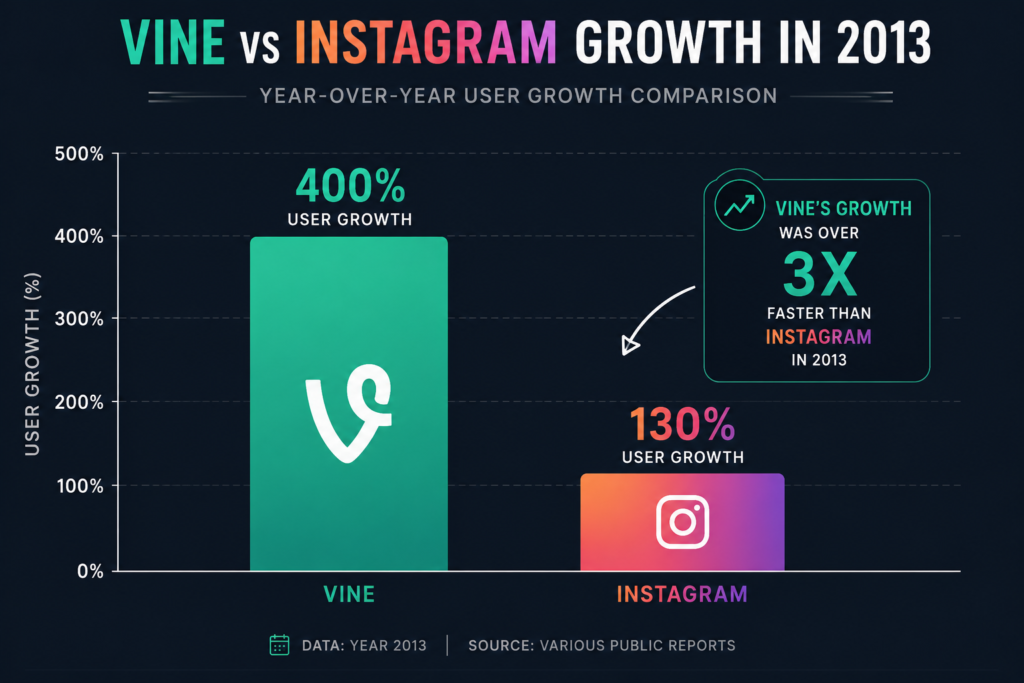
Vine launched on January 24, 2013, and its growth curve was, for a moment, one of the fastest ever recorded for a consumer app. It became one of the fastest-growing apps of its time, reaching approximately 40 million users only seven months after its debut. Analysts estimated user growth of over 400% during the first three quarters of 2013 alone more than triple Instagram’s growth rate over the same period. By April 9, 2013, Vine was the single most downloaded free app in the entire iOS App Store.
The platform’s constraint became its brand. Forcing every video into a six-second, looping format didn’t limit creativity it concentrated it, turning comedic timing, jump cuts, and physical stunts into a new short-form language. A wave of teenagers built enormous followings purely on Vine: Shawn Mendes started there before his music career, and Jake and Logan Paul built the audience base that would carry them into YouTube stardom worth tens of millions of dollars combined.
By 2014, Vine had expanded to Android, Windows Phone, and a web version, adding 19 new languages along the way. By December 2015, Vine had over 200 million active users, and brands had taken notice sponsorship deals for top Vine stars reportedly ranged from a few hundred dollars up to $40,000 per post depending on follower count. For a brief window in 2013 and 2014, Vine looked less like a Twitter side project and more like the next great media platform.
THE CRACKS APPEAR
Leadership Churn at the Top
In January 2014, co-founder Dom Hofmann announced he would step down as general manager, with Colin Kroll taking over but Kroll himself lasted only three months in the role before also stepping down in April 2014, with both founders moving into advisory roles to pursue their own products. This is a form of founder churn the departure of the people who best understand a product’s original vision, right as it needs steady hands the most. Vine kept growing through 2014 despite this, but the platform was now being run day-to-day by people who hadn’t built it.
The Competitive Clock Started Immediately
The bigger threat arrived faster than anyone at Vine expected. Instagram launched its own video feature in 2013, offering a similar short-form format but unlike Vine integrating monetization options through advertising and brand partnerships from early on. A former Vine executive later described Instagram video’s launch to The Verge as “the beginning of the end”. Instagram’s video feature also removed Vine’s core differentiator (the loop aside) while pairing it with an already-massive existing user base and a functioning ad business the kind of business Vine was never built to have.
No Way for Creators to Get Paid
This is where Vine’s structural weakness became fatal. Vine had no direct way for its stars to earn income through the platform, unlike YouTube’s established creator payment systems, even as creators poured enormous time into filming and uploading content that built Vine’s audience. By 2015, this had become an open revolt. In fall 2015, nearly 20 of Vine’s top 50 creators gathered at an apartment building in Los Angeles known among Viners as a shared house, meeting with Vine’s Creative Development Lead and other company representatives in what amounted to an intervention to save a platform they could see was failing. Organized by creators Marcus Johns and a creator known as Piques, the group proposed that if Vine paid each of 18 top creators $1.2 million and opened a clearer line of communication and product changes, they would commit to producing three Vines per week each.
Vine’s executives declined the proposal, and the creators left as they had warned they would. This is creator monetization in its starkest form: Vine had built an audience economy without building a way to share the resulting revenue with the people generating the content. Vine did eventually loosen its format extending its default video length from six seconds up to 140 seconds by June 2016 but by then, the creators who had defined the platform’s culture had already begun moving their followings to Instagram, YouTube, and Snapchat.
THE COLLAPSE
The end came fast, but it wasn’t really sudden it was the visible consequence of two years of unresolved cracks. On October 27, 2016, Twitter reported third-quarter earnings alongside a restructuring plan. Twitter announced it would cut roughly 9% of its global workforce about 350 jobs as part of that restructuring. Hours after that layoff announcement, Twitter said it was also discontinuing the standalone Vine app, whose shutdown would occur “in the coming months,” despite the service having recently claimed more than 200 million monthly viewers.
Twitter’s announcement offered no explanation for the decision beyond saying it would share more details on its blog and social channels in the future. The company did commit to keeping the Vine website online and letting users download their existing videos, stating: “We value you, your Vines, and are going to do this the right way”.
Timeline of the wind-down:
- October 27, 2016: Shutdown announced alongside Twitter’s Q3 earnings and 9% layoffs
- Late 2016–early 2017: Vine transitions into “Vine Camera,” a video-creation tool with no social feed
- January 17, 2017: The original Vine app is officially discontinued
- April 2018: The Vine video archive site is discontinued, removing public access to years of content
- 2025: New owner X (formerly Twitter) announces it has located Vine’s video archive and is working to restore user access nearly a decade after the shutdown
The pivot to Vine Camera was itself a case study in a failed shutdown strategy: a rebranded app with no upload feed and no community gave former users no reason to open it, and it faded almost immediately.
Twitter’s own framing of the moment made the priorities clear. CEO Jack Dorsey said at the time: “We have a clear plan, and we’re making the necessary changes to ensure Twitter is positioned for long-term growth, language aimed squarely at investors, with no mention of Vine at all. TechCrunch’s report on the shutdown Twitter’s own announcement offered no explanation for the decision beyond promising more details later, Vine wasn’t killed by a single scandal or lawsuit it was quietly cut as a “non-core” line item inside a company fighting for its own survival.
THE VERDICT: WHY DID THEY REALLY FAIL?
- No monetization infrastructure. Vine never built a revenue-sharing mechanism for creators, so its most valuable people had every financial incentive to leave the moment a better-paying alternative existed.
- Product stagnation at the worst possible time. Sticking rigidly to the six-second format for years only loosening it in June 2016, two years after competitors had already diversified meant Vine’s most engaged creators couldn’t evolve their content on the platform that made them famous.
- Leadership churn during the critical growth window. With both Hofmann and Kroll stepping back from operational roles by mid-2014, Vine lost the founders best positioned to make hard product and monetization calls exactly when those calls mattered most.
- Strategic neglect inside a distracted parent company. Twitter itself was fighting acquisition rumors, activist investors, and its own growth problems by 2016; Vine was never going to win internal resources against Twitter’s core product.
- Competitive timing. Instagram’s 2013 video launch and Snapchat’s rising ad business arrived exactly as Vine needed to consolidate its lead turning a category Vine invented into one it couldn’t defend.
HOW THIS PROBLEM IS SOLVED TODAY
Vine’s core failure an audience-building platform with no way to pay the audience-builders is now treated as a solved problem, at least in principle, by every major short-form video platform that followed it.
TikTok launched its Creator Fund in 2020 with an initial $200 million pool, later expanded toward $1 billion. That original fund paid out roughly $0.02 to $0.04 per 1,000 views, making it functionally impossible to earn meaningful income from the fund alone evidence that simply having a monetization program isn’t sufficient if the payouts don’t reflect real value. TikTok discontinued the Creator Fund in December 2023, transitioning creators to the Creativity Program, later rebranded the Creator Rewards Program in 2025, which requires longer-form content but pays substantially more per view. TikTok reported that creator earnings jumped 250% from September 2023 to March 2024 under the new system, with the number of creators earning $50,000 a month nearly doubling.
Instagram and YouTube took a different route, layering ad-revenue sharing, brand-partnership tools, and Reels bonuses directly into platforms that already had functioning ad businesses the exact structural advantage Vine lacked as a feature bolted onto Twitter. Third-party firms like Collab have also emerged specifically to help former Vine stars monetize old content that keeps resurfacing on YouTube, effectively cleaning up value Vine itself never captured. Collab said it has paid out more than $100 million to video creators, many of them former Vine stars who saw others uploading and monetizing their old clips on YouTube.
None of this makes creator monetization a solved problem in absolute terms. TikTok’s own reversal shows platforms are still experimenting but every major player now treats “how do creators get paid” as a launch-day question, not an afterthought. That single sequencing change is Vine’s most direct legacy.
KEY LESSONS FOR FOUNDERS & INVESTORS
Pay the people building your platform’s value, early. Vine let 18 of its biggest stars walk away rather than negotiate a monetization deal and lost the cultural relevance that came with them.
An acquisition isn’t a finish line. Selling to Twitter before launch gave Vine capital and distribution, but it also meant Vine never had to build an independent business model and it paid for that dependency later.
Product constraints need an expiration date. The six-second format made Vine distinctive in 2013 and limiting by 2015; waiting until mid-2016 to loosen it came after the platform’s top talent had already left.
Leadership continuity matters most during a competitive threat. Both co-founders stepped back from day-to-day roles right as Instagram’s video launch demanded a decisive response.
Being “non-core” inside a bigger company is a real risk. Vine’s fate was ultimately decided by Twitter’s own financial pressure, not by Vine’s user numbers a reminder that acquired products live or die by their parent’s priorities, not just their own metrics.
FAQ — PEOPLE ALSO ASK
Q: Why did Vine failed? A: Vine failed primarily because it never built a way for creators to earn money on the platform, which led its most popular stars to move their audiences to Instagram, YouTube, and Snapchat once those platforms offered better monetization and format flexibility. Twitter’s own leadership churn and financial pressure compounded the problem, and the company shut Vine down in October 2016 as part of a broader cost-cutting restructuring.
Q: What happened to Vine’s founders afterward? A: Dom Hofmann went on to create the apps Peach and Byte, a spiritual successor to Vine that later merged into Clash and then Huddles before being discontinued in 2023. Rus Yusupov and Colin Kroll co-founded the trivia game app HQ Trivia, which reached a $100 million valuation in early 2018 before losing momentum; Kroll died in December 2018 at age 34.
Q: Could Vine have survived if it paid creators? A: It’s plausible but not certain paying the 18 creators who asked for $1.2 million each in 2015 might have slowed the exodus, but Vine would still have faced Instagram’s larger user base, integrated advertising, and Twitter’s own strategic neglect of the product. Monetization alone likely delays rather than solves platform risk when a parent company deprioritizes the product.
Q: What lessons can entrepreneurs learn from Vine’s collapse? A: The clearest lesson is that audience-building and revenue-sharing need to be designed together, not sequentially waiting to solve creator monetization until creators are already leaving is usually too late. A second lesson is that being acquired removes some startup risk but introduces a new one: dependency on a parent company’s own priorities and financial health.
Q: What happened to Vine’s video archive after the shutdown? A: The original Vine app was discontinued on January 17, 2017, and the standalone archive website — which let users watch and download old Vines was itself discontinued in April 2018, cutting off public access entirely. In 2025, new owner X said it had located the archive and was working to restore user access to it, nearly nine years after the platform’s shutdown was first announced.
BUSINESS GLOSSARY
Creator monetization — The systems a platform uses to pay the people who make its content, such as ad-revenue shares or fixed creator funds; Vine’s absence of this is the central failure point in this case study.
Founder churn — When a company’s original founders leave operational roles in quick succession; Vine experienced this in 2014 when both Hofmann and Kroll stepped back within months of each other.
Monthly active users (MAU) — The number of unique users who engage with a product at least once a month, used as the standard growth metric for consumer apps like Vine.
Acqui-hire — An acquisition made primarily to bring on a team and its unfinished product rather than an established business; Vine was bought by Twitter this way, before it had even launched publicly.
Network effect — The way a platform becomes more valuable as more people use it, since users attract more users; Vine’s early growth was driven by this, and its later decline was the same mechanism running in reverse.
Platform risk — The danger a smaller product faces of losing internal priority, funding, or support once absorbed into a larger parent company; Vine’s ultimate shutdown was as much a function of Twitter’s own troubles as of Vine’s user numbers.
Product-market fit — The degree to which a product satisfies genuine, sustained market demand; Vine achieved this quickly with users but never found it as a standalone business.
Vine proved that a six-second idea could become a cultural institution faster than almost anything before it and that cultural relevance alone isn’t a business model. The platform’s collapse wasn’t a single event; it was two years of unpaid creators, absent leadership, and a distracted parent company arriving at their logical conclusion in October 2016.
If you’re building or backing a platform that depends on creators, users, or any third party to generate its core value, the Vine case study is worth studying before you scale, not after. Zano Drone Kickstarter Failure: How $3.6M Vanished in 2015 breaks down a similar collapse in more detail. Follow Venture Graph on Instagram [@venturegraphofficial] for the carousel breakdown of this story, and subscribe for the next case study in your inbox.