
The Arrivo Collapse: Executive Summary
- The Promise: Founded in 2017, Arrivo promised to build a high-speed transportation network capable of moving vehicles at 200 mph.
- The Capital: Secured state tax incentives and announced a massive $1 billion line of credit to build a test track in Colorado.
- The Pivot: Abandoned its core vacuum-tube hyperloop technology in favor of an open-air maglev system right before a critical fundraising window.
- The Outcome: The Arrivo failure culminated in December 2018. The company vanished in 13 months without building a single track, leaving its $20M venture dead in the water.
On December 14, 2018, the remaining employees of Arrivo Corporation learned their jobs were gone. There was no all-hands meeting. There was no official company-wide email from the CEO. They were laid off via text message on a Friday.
At its peak, Arrivo was touted as a top-three contender in the race to build the future of transportation. It boasted a founder with SpaceX pedigree and a supposedly bottomless war chest. Yet, as highlighted by the data, this was a hyperloop clone that ultimately vanished in 13 months, burning through its roughly $20M runway without ever laying a single inch of physical track.
Table of Contents
BACKGROUND & CONTEXT: The Fallout Before the Founding
To understand the Arrivo failure, you have to understand the messy genesis of the company. The story begins not with a bold new vision, but with a bitter corporate divorce.
Brogan BamBrogan, a former SpaceX propulsion engineer, had already made a name for himself as the co-founder and CTO of Hyperloop One. Between 2014 and 2016, Hyperloop One was the undisputed darling of the transportation tech sector, raising over $130 million to chase the dream of vacuum-sealed, supersonic transit.
But in the summer of 2016, that partnership violently imploded.
BamBrogan departed Hyperloop One and immediately filed a lawsuit alongside three former colleagues. They alleged a breach of fiduciary duty and severe mismanagement. The lawsuit became infamous in Silicon Valley for a bizarre detail: BamBrogan’s camp claimed a surveillance camera caught a superior leaving a noose on his desk. Hyperloop One’s counter-suit claimed it was merely a lasso, as BamBrogan famously wore a cowboy hat to work.
Hyperloop One countersued for at least $250 million, accusing BamBrogan’s faction of attempting an illegal corporate coup. Both sides eventually settled confidentially in late 2016, but the reputational damage was done. The legal bloodbath left a cloud over BamBrogan’s leadership style.
Months later, in February 2017, BamBrogan resurfaced. He announced the launch of Arrivo, an LA-based startup built directly from the wreckage of his old team. Joined by several former SpaceX and Hyperloop One alumni, BamBrogan pitched Arrivo as the superior, drama-free hyperloop clone. The new team aggressively claimed they could get operational projects running within just three years.
THE RISE: Colorado Dreams and Billion-Dollar Headlines
For the first year, Arrivo looked completely unstoppable. BamBrogan’s Brogan BamBrogan startup aggressively courted the media, selling a vision that matched the hype of his former employer. By mid-2017, the company had roughly twenty employees and was routinely named by tech publications as a primary contender in the global hyperloop race.
The real momentum seemed to materialize in late 2017. Arrivo struck a deal with the state of Colorado to build a high-speed transit network. They leased office space in an unused toll plaza on E-470 in Commerce City, outlining plans to hire forty engineers. The state of Colorado sweetened the deal, offering $760,000 in tax incentives to anchor the company in the region.
BamBrogan boldly projected a ten-year payback period for the infrastructure and promised to break ground by 2019, targeting a fully operational commercial opening by 2021.
Then came the headline that shocked the industry. In July 2018, Arrivo announced it had secured a massive $1 billion line of credit from Genertec America, a subsidiary of a Chinese state-owned infrastructure conglomerate. On paper, it was a staggering victory. It created the illusion that Arrivo had the financial backing to turn its CGI renderings into actual steel and concrete.
THE CRACKS APPEAR: The Infamous Maglev Pivot
Behind the glossy Colorado press conferences and the billion-dollar headlines, Arrivo was quietly suffocating.
The first major crack was technical. Building a traditional vacuum-tube hyperloop requires maintaining a near-vacuum inside a massive, sealed tube over miles of varied terrain. It is a nightmare of thermodynamics, materials science, and civil engineering. Realizing this was practically impossible on a startup’s timeline, Arrivo made a fatal strategic swerve in November 2017.
They abandoned the vacuum-tube concept entirely.
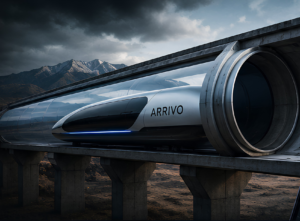
Instead, the company executed a maglev pivot. They shifted their pitch to a 200 mph magnetic levitation system designed to shuttle cars not just passengers, to and from Denver International Airport. While this was likely the most honest engineering decision the team could make, it destroyed their narrative.
This maglev pivot confused investors who had bought into the world-changing hype of a true hyperloop. Arrivo was suddenly pitching a localized, open-air magnetic toll road right when they desperately needed to close a Series A funding round to survive.
Simultaneously, the internal culture was reportedly deteriorating. BamBrogan’s history of erratic behavior resurfaced. According to industry reporting, BamBrogan allegedly brought an axe into the Arrivo office and used it to punch holes in a wall a move reportedly described as a “stress reliever.”
For investors already spooked by the tech pivot, an axe-wielding CEO was a massive red flag. The lack of faith at the top became undeniable when two key co-founders, Andrew Liu and Jadon Smith, quietly resigned in the months leading up to the final shutdown.
THE COLLAPSE: A $20M Failure via Text Message
The end of Arrivo was shockingly abrupt. Despite the public posturing and the purported $1 billion credit facility, the company was utterly out of usable cash.
The $1 billion Genertec deal was a line of credit intended for construction it was not liquid equity funding meant to keep the lights on and pay engineers. To survive and actually draw on that credit, Arrivo needed to close a traditional Series A venture round.
With the narrative muddied by the maglev pivot, the executive team fractured, and the CEO’s reputation severely damaged, venture capitalists simply walked away.
In November 2018, desperate to extend their runway, Arrivo furloughed its entire staff. The executive team spent a frantic month trying to secure a last-minute lifeline. It never materialized.
On December 14, 2018, the Arrivo failure became official. Unable to secure capital, the company shut down its operations completely. The remaining staff, who had been waiting in limbo for weeks, received the fatal news via a simple text message.
Unlike the dramatic lawsuits that characterized BamBrogan’s exit from Hyperloop One, Arrivo’s death was remarkably quiet. There are no public records of a formal Chapter 11 bankruptcy filing or creditor lawsuits. The company simply ceased to exist, vanishing with its roughly $20M in early funding burned.
In roughly two years of operation, Arrivo never produced a working prototype. They never laid a single inch of track for either their original hyperloop concept or the revised maglev design.
THE VERDICT: Why Did They Really Fail?
The Arrivo failure wasn’t a failure of physics; it was a failure of corporate strategy. Here is why the company actually collapsed:
- The Mid-Flight Narrative Pivot: Switching from a vacuum-tube hyperloop to an open-air maglev system was a massive bait-and-switch. It happened exactly when the company needed to sell a clear, confident story to Series A investors, killing their momentum.
- Confusing Debt with Runway: Announcing a $1 billion line of credit created a false sense of security. Credit lines finance physical construction; they do not pay for the software engineers and R&D required to invent the technology in the first place.
- Unshakeable Founder Baggage: Investors underwrite founders. BamBrogan’s highly publicized, litigious exit from his previous company, combined with rumors of erratic office behavior (the axe incident), made him an uninvestable liability when times got tough.
- No Physical Proof Point: In hardware startups, CAD drawings only get you so far. Arrivo asked investors for tens of millions of dollars without ever building a scaled test track to prove their proprietary magnetic tech actually worked.
- Executive Flight: Losing two co-founders just months before running out of cash sent a blinding red warning signal to the venture capital community that the ship was already sinking.
HOW THIS PROBLEM IS SOLVED TODAY
Arrivo’s core failure burning massive capital on speculative infrastructure without a physical milestone is a trap the deep-tech industry is still trying to escape. However, subsequent companies proved that even fixing Arrivo’s mistakes isn’t enough to guarantee survival.
Take Europe’s Hardt Hyperloop as the ultimate modern counter-example. Unlike Arrivo, Hardt actually built physical infrastructure. Spun out of Delft University, Hardt raised over $50 million and successfully constructed a 420-meter vacuum test tube. By late 2025, they had demonstrated a verified 85 km/h speed record and executed a complex track-switching maneuver.
Yet, despite having the physical proof points Arrivo lacked, Hardt Hyperloop still met a grim fate. In March 2026, a Dutch court declared Hardt bankrupt after a critical European public funding grant fell through. Just weeks later, their Spanish rival Zeleros also filed for insolvency.
Today, the transportation tech sector realizes the problem is structural. Building new right-of-way infrastructure requires a financing model closer to national railway bonds than traditional Silicon Valley venture capital. Startups today are increasingly partnering directly with sovereign wealth funds and military defense contractors from day one, realizing that private VC simply cannot bridge the “valley of death” between a prototype and commercial deployment.
KEY LESSONS FOR FOUNDERS & INVESTORS
- Don’t pivot your core technology mid-fundraise. If you change your fundamental product architecture, you must accept that you are starting your investor outreach over from zero.
- Headline capital isn’t always runway. A massive line of credit or a government tax incentive is useless if you don’t have the liquid equity (cash) required to survive long enough to use it.
- Founder reputation is a finite resource. Silicon Valley has a long memory. If a founder leaves a trail of messy lawsuits and erratic behavior, investors will pull their term sheets the second the company hits a speed bump.
- Executive attrition is a leading indicator. When key co-founders quietly exit a pre-revenue startup, smart investors immediately pause funding to look for the hidden cracks.
- Physical proof beats press conferences. In deep tech, CGI renderings and bold claims have a rapidly expiring shelf life. You must prioritize building a physical, de-risked prototype above all else.
FAQ — PEOPLE ALSO ASK
Q: Why did Arrivo fail? A: The Arrivo failure occurred because the company ran out of cash and failed to secure a Series A funding round. This happened immediately after they confused investors by pivoting away from their original hyperloop concept to a maglev system.
Q: What happened to Brogan BamBrogan afterward? A: BamBrogan eventually returned to the aerospace sector. In May 2022, he co-founded Ethos Space, a startup focused on lunar infrastructure and manufacturing, where he oversees customer operations and integration.
Q: Could Arrivo have survived? A: It is highly unlikely. Even if they had maintained a consistent story and secured a Series A, the later bankruptcies of companies with actual working prototypes (like Hardt Hyperloop) prove that venture capital is poorly suited for funding trillion-dollar physical infrastructure from scratch.
Q: What lessons can entrepreneurs learn from Arrivo? A: Narrative consistency is just as vital as engineering truth when raising money. A sudden pivot to a new technology can destroy investor trust if not managed with total transparency and a new proof of concept.
Q: Did Arrivo ever draw down its $1 billion line of credit? A: No, Arrivo never utilized the $1 billion Genertec credit facility. That money was earmarked strictly for physical construction costs in Colorado, but because the company could not raise the operating capital required to finalize the engineering, the construction never began.
BUSINESS GLOSSARY
- Series A — The first significant round of venture capital financing a startup receives after its seed stage, meant to optimize its product and user base. Arrivo’s inability to close a Series A directly caused its death.
- Furlough — A temporary, unpaid leave of absence imposed on employees, often used by companies trying to freeze cash burn before a total shutdown.
- Maglev (Magnetic Levitation) — A transport method using magnetic fields to lift and propel vehicles, eliminating friction. This is the technology Arrivo pivoted toward before its collapse.
- Vacuum-tube hyperloop — A proposed transit system where pods travel through sealed, low-pressure tubes to achieve airline speeds.
- Line of credit — A preset borrowing limit that a company can tap into at any time. It is debt, not equity, meaning it must be paid back and cannot be used freely for standard operating expenses unless specified.
- Bankruptcy — A legal proceeding involving a person or business that is unable to repay outstanding debts. Notably, Arrivo never filed for formal bankruptcy; they simply shut their doors.